
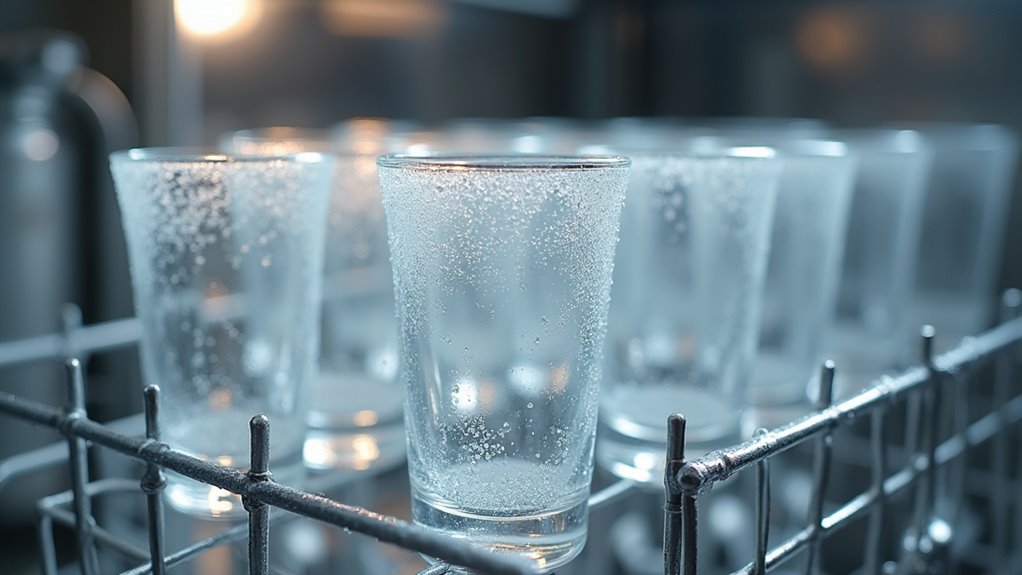
A white film on glasses often comes from hard water minerals left behind after drying. Excess detergent or too much detergent powder can create a chalky residue. Weak rinse cycles leave soap traces that dry into a cloudy layer. Sometimes the water supply itself contains high mineral content that causes persistent cloudiness. Identify the cause — minerals, detergent overload, or poor rinsing — to choose the right fix and restore clear glassware.
What Causes White Residue on Glasses?
A cloudy glass can feel frustrating, especially once you expected a clean shine instead of a dull film. You’re usually seeing minerals, leftover soap, or both.
Hard water drops leave calcium and magnesium behind as they dry, so tiny white marks stay on the glass. At the same time, detergent chemistry matters because too much soap, or soap that doesn’t dissolve well in cooler water, can cling as streaks.
Your glass temperature also affects drying, since warm spots can speed up evaporation and trap residue. Should your washer rinse weakly, or dishes crowd the rack, perhaps you’ll keep a thin film on the surface.
Even a softener can leave traces unless it’s set too high, so the cycle and the water need to work together.
Hard Water Spots and Soap Film
When your glasses come out with chalky white spots, hard water is often the culprit.
Those mineral deposits can stay behind as the water dries, while soap film can mix with detergent and leave a cloudy smear that feels stubborn and a little rude.
You can usually tell the difference by how the residue looks and wipes away, and that clue helps you fix the right problem.
Hard Water Mineral Spots
Those chalky white spots on your glasses usually come from hard water, not from a dirty dishwasher. In scale chemistry, calcium and magnesium ride in with rinse water, then dry into a pale crust. That’s why mineral mapping matters: it shows where droplets sit and leave marks.
Should you use a water softener, you might cut classic scaling, but very alkaline wash water can still etch glass over time. You’re not stuck with the look, though. A rinse aid helps water sheet off, so fewer beads dry in place. The right detergent dose and a hot cycle, around 120 to 150°F, also reduce spotting.
Were the white haze to wipe away, it’s mineral deposit. Were it to refuse to budge, your glass could have permanent etching.
Soap Film Residue
Sometimes the white haze on your glasses isn’t hard water at all, and that can feel extra frustrating because the dishwasher looks clean while your glass still comes out cloudy.
You might be seeing soap film residue. Whenever detergent doesn’t dissolve fully, or you use too much, a thin film can stay behind. In soft water, a full pod can leave excess buildup; in hard water, too little detergent could do the same.
This is where surfactant chemistry matters, because low-water cycles and cooler water under 120°F can block rinsing. Consumer perceptions often miss this difference, since the haze rubs off with a wet finger.
To help, adjust dosage to your water, add rinse aid, and load glasses so water sheets off freely.
Why Glasses Pool Water in the Dishwasher
You may notice water pooling on your glasses whenever their shape creates flat spots, like wide bases, deep rims, or concave bottoms.
In case the rack holds them too level or crammed too close together, the spray can’t reach every angle, and the water just sits there.
Even a slow drain or weak circulation could leave those little puddles behind after the cycle ends.
Glass Shape And Angles
Whenever glass shape works against you, water can hang on long after the wash cycle ends.
Your glass geometry matters more than you might reckon. Straight sides, deep bowls, and tall narrow shapes can trap rinse water because the drain angle stays too flat. Once the interior feels almost square, water can’t sheet off well, so droplets stay behind.
Decorative rims, concave details, and thick bases add tiny ledges where spray misses and minerals settle as water dries. Should you use glasses that sit level, they hold even more water in the bottom. A slight tilt helps the flow move toward the center and out.
Rack Position And Drainage
In the rack, a glass can look safe and still hold onto water like a tiny bowl. Whenever you set it flat, or nest it against the tines, you trap wash water in little dips and creases.
During drying, that pooled water evaporates and leaves mineral spots behind, which can make your clean glass look cloudy. Modern machines use less water, so good rack drainage matters even more.
Provided your dishwasher offers a tilt adjustment, lift one side or lower the other so water runs off faster. Also, keep glasses spaced apart, not stacked or squeezed together.
Check that the spray arms can turn freely, because blocked spray can push water into concealed pockets. A small change in position can help you feel like your glasses truly belong in the clean-up.
What Dishwasher Settings Make Spots Worse?
Although a dishwasher should make glassware sparkle, the wrong settings can turn a clean load into a spotty mess. Eco and other low temp cycles, plus shortened rinses, often leave more detergent behind, so glasses dry with film. Too much detergent can do the same, especially in softened water. Heated dry and Extra Dry can also push water off too fast, and hard water might leave specks.
| Setting | Effect | Better Choice |
|---|---|---|
| Eco | More residue | Standard wash |
| Short rinse | Less cleanup | Full rinse |
| Extra Dry | More spotting | Lower heat dry |
| Too much detergent | Buildup | Measure less |
| High softener salt | Etched look | Match hardness |
You’ll fit in better with your machine if you trial one setting at a time and keep records.
How Rinse Aid Stops White Residue on Glasses
Rinse aid helps you beat white residue by changing how water behaves on your glasses. It uses surfactants and wetting agents to make water sheet off instead of bead up, so fewer mineral spots get left behind as the glass dries.
In case your water is hard, you can adjust the dispense level to match it, and that small tweak can make a big difference.
Rinse Aid Basics
A little rinse aid can make a big difference whenever your glasses keep coming out with that chalky white film. It works through changing rinse mechanics, so water sheets off instead of beading into tiny drops that dry and leave minerals behind. You’ll usually find an adjustable dispenser, so try dispensing adjustments according to your water. Use a lower setting for soft water and a higher one for hard water.
Once the rinse aid cuts surface tension, hot rinse water drains more evenly and your glasses dry clearer. In case your water is very hard, you might need a higher setting or a product with stronger sheeting power. Also, keep your dishwasher clean and load it well, because clogged spray arms or extra detergent can mess with that smooth, shared sheeting action.
Preventing White Film
More often than not, that white film on your glasses shows up because water dries too slowly and leaves tiny minerals behind. Rinse aid helps you beat that through making water sheet off the glass, not bead up. Whenever you set the rinse concentration right, you cut spotting fast, even in hard water.
To keep your glasses clearer, try this:
- Start with the dispenser’s default setting.
- Adjust application timing so each cycle gets a full dose.
- Raise the dose provided you still see streaks, or lower it in case you notice rainbow marks.
Use it every wash, not just once in a while, because steady use works better. Suppose your water is very hard, pair rinse aid with dishwasher salt or a softener. Hot water and fully dissolved detergent also help you keep that clean, shared-table shine.
When Detergent Leaves a Film on Glasses
Should your glasses come out cloudy or streaked after a wash, the detergent could be the one leaving the mess behind.
You’re not doing anything wrong. In detergent chemistry, too much cleaner, especially a concentrated pod or tablet, can outlast the rinse. Once that happens, a thin film stays on the glass.
Solubility checks show this risk grows in cooler water, under 120°F, or in short cycles, because the detergent doesn’t fully dissolve.
You can often fix it through using about half the normal dose in soft water or through choosing a gentler gel. Also, pods add rinse aid, so they can clash with your water or cycle.
Should your water be softened, too much alkalinity can make the haze feel chalky and stubborn.
How Dirty Filters and Spray Arms Cause Spots
Once the filter gets clogged, your dishwasher can start recycling the same dirty water instead of washing it away, and that’s often what leaves spots on your glasses.
With clogged filters, food bits and grease drift back onto glassware, so the finish looks cloudy and tired. Good spray arm maintenance matters too, because blocked holes cut water pressure and leave detergent half-rinsed.
- Remove and rinse the filter every 1 to 2 months.
- Check spray arm holes with a toothpick and clear buildup.
- Run a cleaning cycle each month to keep water moving right.
When spray arms stick or spin poorly, some glasses miss the full rinse and keep little white marks.
A quick check helps you protect your dishes and feel more at home with every load.
How Water Softener Settings Can Etch Glass
Sometimes the problem isn’t dirt at all, and that can feel extra frustrating whenever your glasses already looked clean. Should your softener calibration runs too high, your dishwasher can leave more sodium in the wash water. That raises alkalinity, and with very hot cycles plus strong detergent, your glass might start to etch.
| Setting | What happens | What you notice |
|---|---|---|
| Too much softening | More sodium buildup | Cloudy glass |
| Hot water | Faster leaching | Dull shine |
| Heavy pods | Stronger alkalinity | Frosty look |
You could ask for a softer setting and check regeneration timing. That small change could protect your favorite cups and keep your kitchen crew smiling together.
How To Tell If Glass Etching Is Permanent?
Spotting permanent etching starts with a close look at the glass, because the damage usually has a soft, frosty haze that stays put no matter how much you scrub. You can check etch permanence by examining the surface, not your patience:
- Wash the glass by hand with hot water and a mild baking soda paste.
- Try a household descaler like vinegar or CLR.
- Notice whether the cloudiness still looks even, matte, and faintly scratch-like.
In case the film won’t budge, you’re likely contending with real etching, not leftover residue.
That matters because etched glass often loses shine and shows scratches more clearly. In tough cases, microscopic analysis can reveal surface wear you can’t see up close.
Should your glass still look cloudy after several tries, you’re not alone, and it’s probably permanent surface damage.
How To Clean White Residue Off Glasses
As soon as that cloudy film shows up on your glasses, you can usually clear it away with a little patience and the right cleaner.
Initially, rub the spot with warm water and Dawn or plain dish soap. In the event the haze lifts, you’re contending with residue, not damage. Then use a soft sponge with a 1:1 mix of warm water and white vinegar, and finish with microfiber buffing to bring back the shine.
For tougher buildup, give the glasses a vinegar soak for 10 to 20 minutes in 1 part vinegar to 3 parts warm water. Rinse well and dry right away.
Should the film still looks dull after that, the glass could be etched, and you can’t fully fix it.
How To Prevent White Residue On Glasses
The positive news is that you can usually keep white residue off your glasses with a few small dishwasher tweaks. Start by choosing the right settings and loading style. In case you use softened water, adjust detergent and use about half the usual pod or tablet amount. Then add rinse aid at a moderate level so water sheets off instead of drying in spots.
- Run the hottest cycle your machine offers.
- Angle glasses between tines so water doesn’t pool.
- Keep racks uncrowded and use the air dry technique after the wash.
Also, clean the filter, spray arms, and run a monthly hot cycle with vinegar or citric acid. These simple habits help you protect your glassware and feel at home with every clean load.
When To Call For Dishwasher Repair
Should you’ve already adjusted detergent, rinse aid, and loading style but those cloudy marks still keep showing up, it could be time to call for dishwasher repair. Once you see these diagnostic indicators, you’re not failing your dishes, and you’re not alone.
| Sign | What it can mean |
|---|---|
| White film on many loads | Internal scaling or a weak valve |
| Loud motor noise | A worn pump or spray problem |
| Standing water | Drainage trouble or low pressure |
Assuming the spray arms won’t spin freely, water stays cool, or your water is hard, service scheduling makes sense. A technician can examine the heater, inlet valve, and control settings before the damage spreads. In case your dishwasher is under warranty, ask for a certified brand visit so you can protect your glasses and your peace of mind.
Frequently Asked Questions
Can White Residue Affect Crystal Glasses Differently?
Yes, you can see it differently on crystal glasses: they are more delicate, so mineral buildup and soft etching show faster. You belong in careful care—use gentler detergent, lower heat, and shorter cycles.
Does Handwashing Help Remove Dishwasher Residue Faster?
Yes, handwashing can clear residue faster; it is the initial aid for cloudy glasses. You will use hot water and a soft sponge, and you will feel right at home with sparkling results and less waiting.
Can Certain Glass Brands Be More Prone to Spotting?
Yes, you can notice more spotting on some glasses. Soda lime glass often shows mineral marks more easily than borosilicate glass, so you might feel frustrated. Choosing better made pieces can help you feel more included, too.
Is White Residue Harmful to Drink From?
Usually you’re fine; I once drank from a cloudy mug at a friend’s house and lived to laugh about it. That white film is often mineral buildup from water hardness effects, not something toxic.
Should I Pre-Rinse Glasses Before Loading Them?
No, you should not fully pre rinse glasses. You’ll get the best results by scraping off bits and letting detergent work. Pre rinsing offers limited benefits, and water hardness still affects your dishwasher’s performance.