Inverter microwaves deliver steady, lower-power cooking for gentler thawing and more even reheating. Traditional microwaves cycle at full power, producing bursts that can overcook edges while leaving centers cold. That power delivery difference affects defrosting, softening, and reheating performance. Energy use and feature sets often favor inverter models for precise control, while traditional units remain common and affordable. This article compares performance, efficiency, and real-world cooking results to help pick the best microwave for everyday needs.
What Is an Inverter Microwave?
An inverter microwave changes how power reaches the magnetron, and that’s the big reason it feels different in use.
You get a smart inverter system that sends steady, adjustable power instead of sharp bursts. So whenever you set lower heat, it keeps feeding that level continuously, which helps you feel more in control.
This compact design often shows up in higher-end models, and it can fit neatly into your kitchen routine without fuss.
Because the cavity stays more consistent, you can trust it for gentle defrosting, melting chocolate, or cooking eggs.
Panasonic initially made this idea popular, and now many brands use it.
You won’t usually see a lower power bill, but you’ll notice smoother, calmer cooking that feels easier to share.
How Do Traditional Microwaves Cycle Power?
Whenever you set a traditional microwave to a lower power level, it doesn’t gently lower the magnetron’s output. Instead, it turns the magnetron fully on and fully off in long cycles, and that duty cycle sets the average power you get.
Power Cycling Basics
Traditional microwaves don’t truly “turn down” their magnetron in a smooth way. Instead, you get full blasts and full pauses.
A TRIAC and transformer switch the high-voltage supply on for a set period, then off again, so a 50% setting might mean about 15 seconds on and 15 seconds off. That long duty cycle can feel a little old school, but you’re not imagining the pulse artifacts. You could hear clicking, and you might notice thermal cycling as food warms, then cools, between bursts.
Because the oven runs at full output during each on phase, standing-wave hot and cold spots can show up more clearly. So, whenever you use lower power, you’re sharing the oven’s stop-start rhythm, not getting a gentle, steady stream.
Duty Cycle Heating
Pulsing the heat, a traditional microwave doesn’t ease power down in a smooth stream; it chops it into full-on bursts and full-off pauses.
When you choose 50 percent, you usually get about 15 seconds on and 15 seconds off in a 30 second cycle.
That duty cycle sets your average energy, but the magnetron still runs at full strength during each pulse.
So should you stop and start the cooking in short bursts, you might get more power than you expected.
This pattern also matters for pulse smoothing, because the long gaps can leave thermal gradients in your food.
You hear the chop, you feel the uneven heat, and you can plan around it with confidence.
How Do Inverter and Traditional Microwaves Compare?
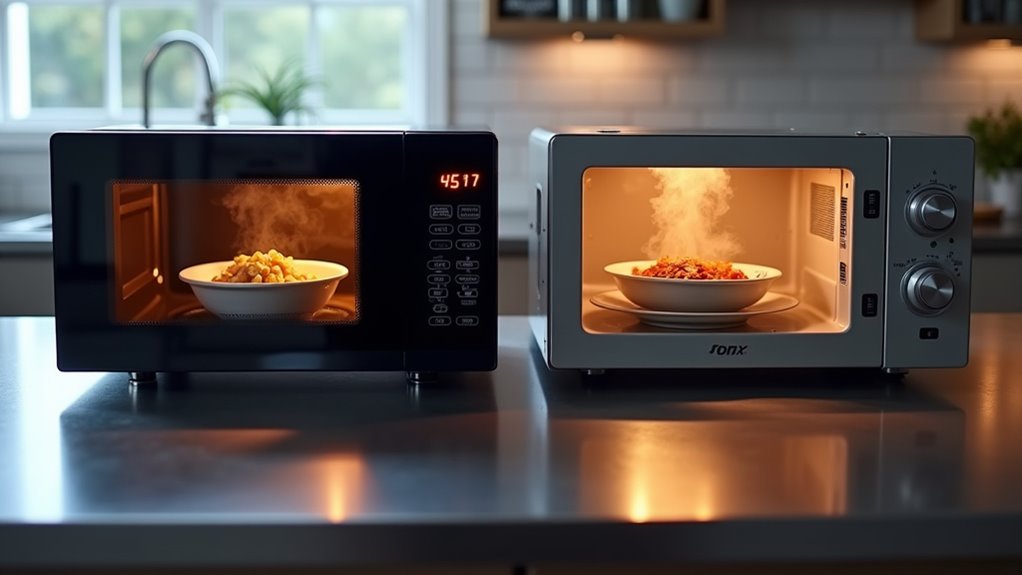
You’ll notice the biggest difference in how each microwave delivers power: a traditional model blasts at full strength in short bursts, while an inverter model gives you a steadier, more even flow.
That sounds like a big win for the inverter, especially during the times you’re melting chocolate or thawing food without scorching the edges. But in real kitchen use, both can cook much the same provided you control time and power, so the best choice often comes down to how you like to cook.
Power Delivery Differences
As soon as you set the power on a microwave, the way it sends energy to your food can feel very different.
With traditional models, you get long bursts of full power, then long pauses. So at 50%, the magnetron might blast, then rest, in big chunks. That can make the sound and warmth seem jumpy.
Inverter models work differently. They use continuous modulation to keep a steady output that matches the setting more closely. You still get the same familiar microwave comfort, but the energy flows in a smoother way.
- a soup bowl with calm steam
- bread warming without sudden hot spots
- a quiet hum instead of hard clicking
- a steady glow on the control panel
- dinner sharing a gentler heat step
Real-World Performance Differences
Whenever you look at how inverter and traditional microwaves actually perform, the surprise is that the gap is often smaller than people expect. In lab trials, both can heat mashed potatoes, reheat leftovers, and melt chocolate with the same results.
Your real difference comes from user habits, sensor calibration, and how much energy you give the food. Traditional models pulse power on and off, while inverters feed a steady low level, so inverter units can feel smoother for defrosting or softening butter. Still, short cooking bursts and smart routines let a PWM microwave do the same job well.
You probably won’t see lower electric bills either, because billing tracks active power, not clever circuit design. For most kitchens, your routine matters more than the badge on the door.
Are Inverter Microwaves Better for Delicate Foods?
As you’re heating delicate foods, an inverter microwave can feel like a kinder helper because it sends a steady, controlled level of power instead of blasting food in short bursts. That steady gentle heating can help you melt chocolate, warm eggs, or soften butter with less drama at the bowl. Still, inverter power alone doesn’t guarantee success, because user technique matters a lot too.
- a glossy chocolate square
- a bowl of softly set eggs
- butter relaxing on a saucer
- warm milk with a quiet swirl
- a spoon pausing beside the dish
You’ll often get the best results whenever you use medium power, stir whenever needed, and trust the process. Conventional microwaves can also do well whenever you work in short steps. So, your skill and the oven’s program both shape the result.
Do Inverter Microwaves Defrost More Evenly?
Even though inverter microwaves sound like they should defrost more evenly, the real answer is a little more mixed. You do get steady, reduced power, so your food can warm more gently and the edges might stay softer. But CHOICE lab trials found no clear real-world win in mean temperature or uniformity, so you can’t count on inverter power alone.
What really matters is the defrost routine, total energy, and your thawing techniques. Because microwaves only penetrate a few centimeters, you still need to flip, rotate, and separate pieces so heat can move inward. Also, sensor calibration can affect results, since a weak routine could underdefrost or overcook the outside. So, should you want better thawing, use low power, stay hands-on, and trust the process, not the label.
Are Inverter Microwaves More Energy Efficient?
As soon as you look past the gentler thawing style of inverter microwaves, the energy question gets a lot less exciting. You might hear that they save power, but CHOICE testing says your energy billing won’t show a real drop. Their switching design can trim losses and even smooth grid harmonics, yet the gains stay tiny at home.
- A soup bowl glows under the turntable light.
- A frozen burrito warms in soft waves.
- A timer ticks beside the fridge hum.
- A kettle and microwave share the same outlet.
- A bill lands in your mailbox unchanged.
In daily heating, reheating, and defrosting, you won’t cook faster or use much less electricity. Standard models and inverter models overlap in yearly cost, so your kitchen can feel calm and connected without expecting big savings.
Which Microwave Features Matter More Than Inverter Tech?
Whenever you compare microwave features, sensor cooking usually matters more than inverter tech, because it helps the oven notice moisture or temperature changes and adjust the heat for you. That sensor importance shows up whenever you reheat leftovers or thaw meat, since the microwave can stop the guesswork and protect your food.
Next, look at cavity design, because a smart layout and well placed turntable can cut hot and cold spots more than inverter power alone. Clear controls, bright viewing, and simple presets also make you feel at home with the appliance, and that confidence matters on busy nights.
For most kitchens, auto-defrost routines and easy use beat fancy circuitry, while energy savings stay too small to drive your choice.
What Do Tests Show About Inverter Microwaves?
Lab trials paint a more balanced image than the hype around inverter microwaves. Whenever you compare seven inverter models with 19 PWM units, you don’t see a big edge in most everyday jobs.
- Mashed potatoes warmed to similar temperatures
- Butter softened in the same gentle glow
- Chocolate melted without drama
- Eggs cooked with near-match results
- Defrost tests depended on software, not just hardware
In other words, your microwave’s controls matter as much as the power system. Inverter units do give steadier power, and examinations show tiny circuit gains, but your bill usually won’t change.
That can shape consumer perceptions, yet long term reliability and cooking technique still decide how your food turns out. So should you want the calm, shared feeling of a kitchen win, the label alone isn’t the hero.
Is an Inverter Microwave Worth the Extra Cost?
So the big question is whether that smoother power flow is actually worth more money in your kitchen. For most of you, the cost justification is shaky because lab trials found no real-world heating edge for everyday reheating, defrosting, or cooking. You’ll also see higher upfront prices, while your power bill usually stays about the same. That’s because household billing tracks active power, not the fancy circuit math behind inverter tech.
Still, your user preferences matter. Suppose you love gentle melting, softer butter, or delicate eggs, an inverter model can feel handy, especially with good sensors and auto-cook settings. But in case you want simple controls, a lower price, and solid basic performance, a well-made standard microwave can fit your home just fine and save you money.
Frequently Asked Questions
Do Inverter Microwaves Last Longer Than Traditional Models?
Usually, you’ll find inverter microwaves can last longer, but it depends on use, care, and build quality. As you compare lifespan comparisons, check warranty considerations too; you’ll feel more confident choosing the right model for your kitchen.
Can Inverter Microwaves Fit the Same Countertop Spaces?
Yes, you can often fit them like puzzle pieces. You will want to check size compatibility, since footprint differences vary per model. Measure your counter, compare dimensions, and you will find a welcoming fit that feels right.
Are Replacement Parts More Expensive for Inverter Microwaves?
Yes, you will often pay more for inverter replacement components, and you might need specialized repair training. You are not alone; many owners find parts pricier, but you could still weigh reliability, efficiency, and long term value.
Do Inverter Microwaves Make Less Noise During Operation?
Yes, you will usually hear quieter operation with inverter models. You get a smoother sound profile, and that can feel more welcoming in your kitchen. Silence is golden; you will likely appreciate the gentler hum and steadier performance.
Which Microwave Type Is Easier to Repair?
Traditional microwaves are usually easier for you to repair because they have simpler circuitry, widely available parts, and less circuit complexity. Inverter models often need specialized serviceability training, so repairs are usually more challenging.