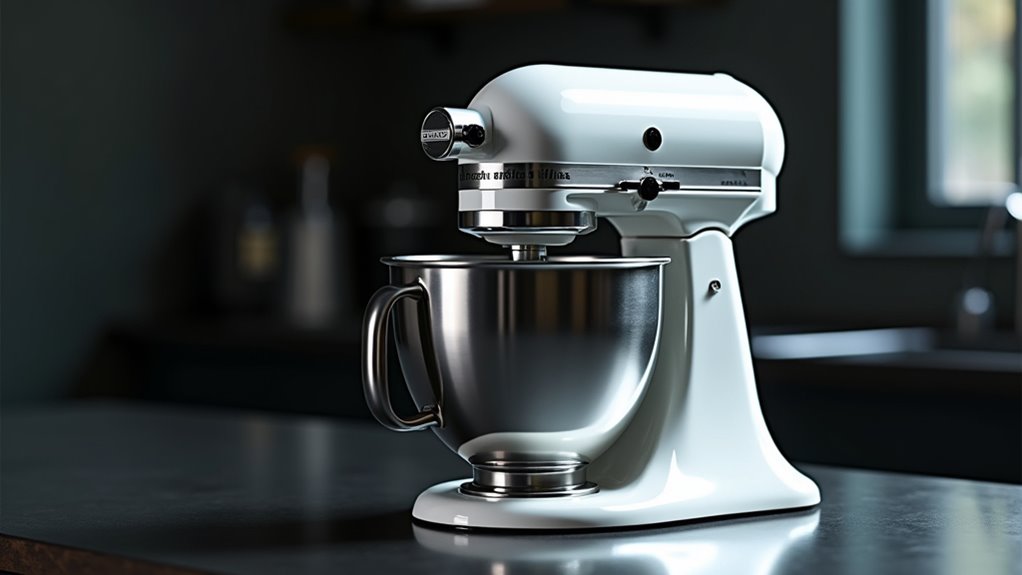
Motor wattage helps gauge a stand mixer’s power, but it doesn’t tell the whole story. Motor torque, solid gears, bowl shape, and usable speed range determine real performance. Tilt-head mixers work well for light batters and small batches. Bowl-lift and commercial-style mixers handle dense dough and long kneading with less strain. Choosing the right design matters more for heavy tasks than focusing only on watts.
What Stand Mixer Motor Power Means
Power can feel like the big promise on a stand mixer box, but the number on the label only tells part of the story.
You might see 275 W, 325 W, or about 575 W, yet that figure shows electrical draw, not the push you feel in the bowl.
Whenever you add a big batch, the mixer asks for more watts, even though the motor parts are the same.
What really helps you knead is torque, plus sturdy gears and good motor efficiency.
Some models share the same internal parts, so a higher label doesn’t always mean a stronger heart.
Instead, look for thermal protection, solid build quality, and reviews that match your baking style.
How KitchenAid Rates Mixer Wattage
KitchenAid rates mixer wattage based on measuring how much power the mixer draws at a maximum simulated load and speed, so the number on the label tells you about electrical use, not pure mixing muscle.
You can find the official rating on the label under the base, and you’ll notice it changes based on model and bowl size, from a Classic to a Professional series.
That’s why you shouldn’t treat wattage as the only clue, because similar motor parts can still show different numbers on paper.
Wattage Rating Method
As you look at a KitchenAid mixer’s wattage number, you’re seeing its electrical draw, not the true muscle at the beater.
During motor trial, KitchenAid measures power at the outlet under a simulated maximum load and max speed, then prints that result on the label under the base. That makes label interpretation easy once you know the rule, but the number still reflects input power, not torque at the head.
Model Differences and Specs
Even so, the wattage you see on a KitchenAid mixer doesn’t always mean a completely different motor inside. You might notice that Classic, Artisan, and Professional models list different numbers, yet some share the same motor assembly. KitchenAid often changes the rating through trim variations, bowl size, or market segment, not just via a new engine under the hood. That’s why motor comparisons can feel confusing.
The spec sheet shows electrical draw at a maximum simulated load, but it doesn’t show the torque you feel in the bowl. So, whenever you compare models, look at gearing, lift style, and gear quality too. Those details shape mixing power, duty, and the everyday fit for your kitchen crew.
Classic Vs. Deluxe Vs. Artisan Power
Whenever you compare the Classic, Deluxe, and Artisan, the Classic sets the baseline with about 275 watts and handles light baking well.
The Deluxe nudges power up to roughly 300 watts, while the Artisan reaches 325 watts and gives you more room for bigger, more frequent batches.
Still, wattage isn’t the whole story, so you’ll want to consider about bowl size, gears, and how you actually mix.
Classic Power Baseline
KitchenAid’s Classic, Deluxe, and Artisan mixers all start from a similar power base, but they’re not built for the same job.
You get a solid entry point with the Classic, and that can feel reassuring whenever you’re building your kitchen routine. It uses about 275 watts, so it suits light mixing and everyday basics.
The Deluxe moves up a bit, with about 300 watts and a handled bowl for a steadier grip.
Then the Artisan reaches about 325 watts and a 5-quart bowl for busier baking days.
- Classic: light tasks and simple batches
- Deluxe: a little more room and ease
- Artisan: larger mixing space for frequent use
Still, wattage isn’t the whole story. Shared parts can make real power variability smaller than you’d expect, and motor warmth matters too.
Artisan Motor Capacity
The Artisan looks like a clear step up from the Classic and Deluxe, but the watt numbers only tell part of the story. | Model | Published watts |
| — | — |
|---|---|
| Classic | 275 W |
| Deluxe | 300 W |
| Artisan | 325 W |
You might see the Artisan’s higher label and assume more muscle. Yet KitchenAid says Classic and Artisan now share the same motor parts, so motor longevity and torque evaluation matter more than the sticker. The real lift often comes from bowl size, gearing, and rated load, not just watts. So in case you want a mixer that feels like it fits your kitchen crew, look at the tasks you’ll tackle, the bowl you need, and the accessories you’ll use. That way, you pick power that matches your rhythm, not just a number.
How Bowl Size Affects Wattage And Load
Because bowl size changes how much mass the mixer has to move, it can also change the wattage you see on the label or in trials. You might notice that a 5-quart bowl often shows more watts than a 4.5-quart one, even whenever the motor is similar. That’s because bowl geometry changes load distribution and mixing behavior, so the mixer needs more effort to keep speed consistency.
- Bigger bowls hold more mass, so the mixer draws more power.
- Published watts often reflect trial load, not a stronger motor.
- Your best match depends on how your batch feels, not just the number.
Whenever you’re comparing models, focus on how the bowl fits your work. A larger bowl can support heavy loads with less strain, and that helps you feel confident in the kitchen.
Tilt-Head Vs. Bowl-Lift For Heavy Dough
Choose a bowl-lift mixer whenever heavy dough is part of your regular routine, since that design keeps the bowl locked in place and helps the machine stay steady under a tough load. You’ll feel more control, and your dough sampling will stay more consistent. In this setup, motor longevity improves because the mixer doesn’t fight as much wobble.
| Mixer type | Best use | Stability |
|---|---|---|
| Tilt-head | Cookies, frosting | Good for light work |
| Bowl-lift | Bread, sourdough | Strong under heavy dough |
| Bowl-lift Pro | Large batches | Best for long kneading |
If you bake only now and then, a tilt-head can still fit your kitchen crew. But whenever you knead dense or big batches, bowl-lift construction gives you the steady support you want, so you can mix with less strain and more confidence.
Which Pro And Commercial Mixers Are Strongest?
In case you want the strongest stand mixers in KitchenAid’s Pro and Commercial range, start with the ProLine and NSF-certified Commercial bowl-lift models. You’re getting a 1.3-horsepower DC motor, all-metal gears, and bowls sized for big batches, so they feel built for your busiest baking days and true commercial durability.
- ProLine 7-qt models give you top strength for home kitchens that work hard.
- NSF-certified Commercial 8-qt units add a metal cage and heavy-duty cord for steady, long-term maintenance.
- Professional 600 and 6500 models sit below them, but they still bring strong bowl-lift power for dough and dense batter.
Also, don’t judge with watts alone. Motor type, gearing, and build quality tell you much more about real torque.
Are Refurbished KitchenAid Mixers Worth It?
Refurbished KitchenAid mixers can be a smart buy provided you know what to look for. You can snag a bowl-lift Pro for about $200 to $300, far below new models. That means you get near-Pro strength for bread and big batches without emptying your wallet.
| Check | Why it helps | Best fit |
|---|---|---|
| All-metal gears | Shows lasting strength | Heavy dough |
| Warranty length | Protects your purchase | Peace of mind |
| Seller reputation | Lowers risk | Any refurb |
If you love refurbished aesthetics, you can repaint the shell or swap bowls and still fit into the KitchenAid crowd. Just confirm attachment compatibility and service history initially. Refurbished tilt-head Artisans save less, so they’re usually less exciting unless you want a simple kitchen buddy.
Which Attachments Need More Power?
Some attachments ask your mixer to dig deeper than others, and that’s where motor power really starts to matter.
Whenever you use dough hooks on stiff or whole-grain dough, you need strong motor torque, and a bowl-lift or proline model can keep up without whining.
Heavy grinders and meat attachments can cause attachment heating fast, so feed ingredients slowly and give the motor breaks.
Pasta rollers also stack load, especially with big batches, so smaller portions help your mixer stay calm.
- Wire whips need quick bursts, not long strain.
- Shredders, juicers, and slicers need steady torque peaks.
- Higher wattage and all-metal gearing help with repeated use.
You’ll feel more confident whenever your mixer matches the task, and your kitchen crew will too.
Frequently Asked Questions
What Stand Mixer Has the Strongest Motor?
You’ll get the strongest motor from KitchenAid’s NSF certified commercial 8 quart bowl lift or ProLine 7 quart models, both using 1.3 hp motors. For power ratings, do a torque comparison, because real world strength depends on more than watts.
Is the Artisan Motor Powerful Enough?
Yes, you’ll find the Artisan powerful enough for most home baking, like a trusty sidekick. Its torque curves handle cakes and moderate doughs, while noise levels stay manageable. For heavy bread, you’ll want a bowl lift Pro.
Which Is Better AC or DC Motor Stand Mixer?
DC motors usually win: you will get better torque control, quieter mixing, and often brushless efficiency for heavy doughs. AC mixers can still suit your kitchen crew provided you bake casually and want simpler, sturdy reliability.