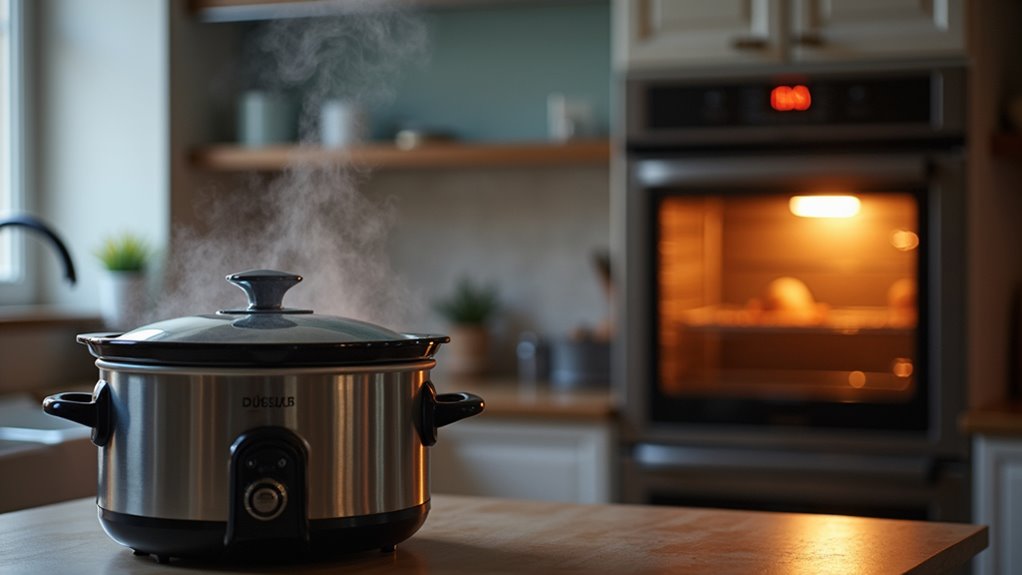
Slow cookers use far less power than conventional ovens. Typical slow-cooker draw ranges from about 70 to 350 watts, while ovens commonly use 1,000 to 2,000 watts. That lower wattage often makes slow cooking more energy-efficient for long, low-temperature meals. Total energy use depends on cook time and preheating needs, plus the recipe’s liquid and food mass. This article compares real energy consumption and practical tips for choosing the most efficient method.
How Much Power Does a Slow Cooker Use?
So, how much power does a slow cooker use? You’re usually looking at about 70 to 350 watts, and your exact model could sit near 132 watts on low or 163 watts on high. That means a medium cooker can feel pretty light on the bill, even if it runs for hours.
Because energy equals power times time, a 200 watt slow cooker used for 8 hours needs 1.6 kWh. Some cookers also shift output during the meal, so the draw won’t stay flat. For that reason, energy meters and smart sockets help you see real use, not just the label.
Whenever you do appliance comparisons, this makes the slow cooker look like a calm, steady teammate in your kitchen.
How Much Power Does an Oven Use?
An oven uses much more power than a slow cooker, and that’s mostly because it has to heat a much larger space.
You’ll often see a fan oven draw about 1 to 2.25 kW while it’s heating, so the jump in demand can feel big.
Once it reaches your set temperature, thermostat cycling kicks in, and the oven turns on and off to hold steady heat. That means the average power drops below the peak.
Preheating can also add about 0.13 to 0.14 kWh, and the oven’s thermal mass keeps it using energy as it warms.
In real use, you might observe an average near 0.6 to 0.9 kW, depending on size, insulation, and how long you cook.
Slow Cooker vs Oven Energy Costs
As you compare slow cooker vs oven energy costs, the answer isn’t as simple as “lower power means lower cost.” A slow cooker sips electricity, usually around 130 to 160 watts, but it runs for hours and hours, so the total can creep up more than you’d expect. That means you should look at kW times hours, not just the sticker power.
In real trials, a 10-hour low cook used about 1.32 kWh, while a one-hour oven casserole used about 0.525 kWh. So, your bill depends on energy pricing and the recipe’s timing. Should you use high for a shorter cook, the gap can shrink.
For your kitchen, lifecycle emissions follow the same math, so smart choices help your table and your wallet.
Why Slow Cookers Need Less Power
You’ll notice a slow cooker uses far less power because it draws a low, steady wattage instead of spiking hard like an oven.
It also heats a small, insulated pot, so less heat escapes into your kitchen and less energy gets wasted.
On top of that, its thermostat cycles the element on and off, which helps it stay warm without burning extra power all day.
Lower Wattage Draw
Slow cookers use surprisingly little power because they only need to hold heat, not blast it. That lower wattage draw comes from a simple heating element that works in short bursts, so you stay in a gentler energy range. In many models, you’ll see about 70 to 350 watts, which feels tiny next to an oven’s 1,000 to 2,500 watts.
Whenever you cook, thermal inertia helps the pot keep warmth steady, while insulation effectiveness cuts waste. Some settings might start higher, then drop once the thermostat settles in. So suppose you’ve ever questioned why your slow cooker feels so efficient, it’s because it’s built to maintain, not rush. You get steady comfort, and your kitchen gets a calmer power appetite.
Smaller Heated Space
The secret is the smaller cooking space. You heat only the ceramic pot and your food, not a huge oven cavity. That tiny sealed chamber keeps warmth close, so less power escapes into the room.
Because the space is compact, targeted conduction does the job with far less effort, and you don’t need a big burst of energy to get started. The lower surface area also means fewer losses to air around it.
So, even at steady heat, your slow cooker can stay comfortable with just 70 to 250 watts, depending on size. An oven has to warm racks, insulation, and extra air, which asks for much more power.
With a slow cooker, you’re part of a smaller, cozier heat zone, and that matters.
Cycled Element Control
Inside a slow cooker, a simple thermostat keeps the heat in check, and that’s a big reason it uses so little power. You don’t get a roaring element; you get cycled control, where the heater turns on, then off, then back on as needed. That thermostat hysteresis helps hold a steady simmer with low wattage.
| Phase | Power |
|---|---|
| Warm-up | 150 W |
| Hold | 132 W |
| Medium run | 150 W |
| Low cycle | 70 to 250 W |
Because of this, you share the heat with the pot, not fight it. The smaller swings also reduce element degradation. And since food volume changes the duty cycle, your real energy use can shift a lot, so measured power tells the truest story.
Low, Medium, and High Slow Cooker Settings
Because each setting uses heat a little differently, you can consider of low, medium, and high as three very different cooking moods.
On this cooker, low pulls about 132 watts, so it feels gentle but steady.
High draws about 163 watts, so it works harder and finishes sooner.
Medium starts out like high, then thermostat behavior and element switching move it to the lower element. That means you get a busy initial stretch, then a calmer finish, with a time average around 147 to 150 watts in trials.
You’ll also notice the switch happens sooner with less food or water.
So, provided you want to match your meal to the setting, reflect about both heat level and cook time.
Low can still use more energy when it runs for hours.
When the Oven Uses Less Energy
Still, an oven can use less energy than a slow cooker whenever the meal is short and the timing is tight.
In case you already preheat it and the food is done in about an hour, you might beat a slow cooker that keeps humming for 8 to 10 hours.
That matters anytime you’re doing meal planning and want dinner to feel easy, not endless. With oven batching, you can cook two dishes at once and spread that warm-up energy across more food, which helps your per-meal use drop.
For recipes that need true low and slow tenderness, the slow cooker could stay ahead. But for many same-day meals, the oven gives you a faster finish and often a smaller energy bill too.
Real-World Cost Examples by Cook Time
At the point you look at real cook times, the energy gap gets much clearer.
Should you simmer a stew for 10 hours on low, your slow cooker can use about 1.32 kWh, or around £0.46 at that rate. That feels friendly for batch cooking, but the hours add up.
In contrast, an oven set to 180°C and run for 60 minutes can use about 525 Wh, so a shorter meal could cost less overall.
Were you to switch to high, a 3-hour cook can land near 489 Wh, which gets close to the oven.
Medium often starts strong, then settles down, so your bill can shift with timing. With seasonal pricing, those little changes matter even more whenever you plan dinner together.
Does Preheating Change Oven Costs?
Preheating can change the bill more than you could expect, even though the oven only runs for a short meal. You pay that initial 137 Wh before food even goes in, so your total jumps fast.
- That startup cost can be about 26% of a 60-minute cook.
- Each extra minute after warmup adds about 6.4375 Wh.
- Skipping preheat can cut a short cook’s cost right away.
- Preheat alternatives help you work with thermal inertia effects.
- Longer cooks spread the one-time loss across more time.
How Food Type Affects Energy Use
The food you cook changes the energy bill more than you may realize, because dense stews and casseroles hold heat longer, while delicate foods need less time and often finish faster in the oven.
You’ll also use more power whenever you brown, sear, or prep food before cooking, since those extra steps add heat before the main cook even starts.
Dense Vs Delicate Foods
At the point you choose between a slow cooker and an oven, the type of food matters just as much as the cooking time. Dense, water-rich foods like stews, braises, and root vegetables soak up heat slowly, so your slow cooker can use gentle energy for hours and still give you good texture retention and nutrient preservation.
- Whole potatoes
- Beef roasts
- Root vegetables
- Leafy greens
- Fish fillets
But delicate foods need a different path. Should you leave greens, fish, or cream sauces in low heat too long, they can deteriorate fast and lose their shape. For cooks, that means the slow cooker fits sturdy meals, while the oven can move dense, dry foods to temperature faster and often with less total energy.
Once you match the food to the heat, you join a smarter, calmer kitchen crowd.
Browning And Prep Energy
Searing meat or vegetables initially can quietly change the energy math, because that extra hob time is part of the real cost of the meal, even in case people often leave it out. Whenever you do hob searing, add that energy to your total before you compare methods. Your mise enplace can help here, since a tidy start cuts waste and keeps the pan work focused.
In the cottage pie example, the browning was left out on purpose, so the numbers showed only appliance use. That matters because a fair trial adds hob searing energy to the slow cooker’s draw and then compares it with the oven’s cost. For many meals, that fuller view is the one that truly fits your kitchen and your table.
Cook Time Differences
Cook time changes the energy illustration more than most people expect, because food type can stretch or shrink the hours your appliance stays on.
Whenever you cook a dense roast, you need long, steady heat and stronger temperature gradients to break it down. That can make a slow cooker use more total energy than a one-hour oven roast.
In cases you cook with vegetable stew, the story shifts, since shorter cooks often fit better with timing strategies that keep the draw low.
- Low settings work best for long, gentle meals
- High settings cut hours and can trim usage
- Smaller batches heat faster and finish sooner
- Tough cuts need patience, not speed
- Quick foods often save energy in the oven
When a Slow Cooker Is the Better Choice
Whenever you’re making a stew, braise, or any dish that needs 7 to 8 hours of gentle heat, a slow cooker is often the smarter choice.
You get steady warmth, so your food cooks evenly while you handle work, family, or rest.
Its safety features and recipe adaptability also help you feel confident, because you can start in the morning and come home to dinner that’s ready.
Since it draws much less power than an oven, it can keep long recipes under 1 kWh on some models.
For leftover chili, soup, or shredded meat, it’s also great for turning scraps into something comforting.
Should you need a dish that fits your day, not the other way around, a slow cooker gives you that easy, welcoming rhythm.
Common Slow Cooker Energy Myths
A lot of slow cooker myths pop up right away, and they can make energy use feel more confusing than it really is.
- Low heat always means low energy
- Longer cook time always saves power
- Nameplate watts tell the full story
- Ovens always waste more electricity
- Every slow cooker draws the same power
These energy myths and temperature misconceptions can steer you wrong.
Your cooker might use just 70 to 250 watts, but long runtimes add up.
A 150 watt model running 8 hours uses about 1.2 kWh.
Meanwhile, a short oven meal could cost less because the thermostat cycles the element.
Some slow cookers even start high, then drop lower, so real use changes during cooking.
Should you want fair comparisons, check actual watt draw and cooking time, not guesses.
Frequently Asked Questions
Does a Slow Cooker or Oven Use More Electricity?
It depends; you will often find the slow cooker wins on appliance efficiency, but your energy comparison changes with cooking time. You belong to the group that measures kWh, because your recipe and settings decide more.
What Is the Equivalent of 8 Hours on Low in Slow Cooker to Oven?
You’d usually match 8 hours on low to about 1 to 2 hours in an oven, depending on temperature equivalence, recipe, and model. Your cooking time can vary, but that’s the closest practical swap.
Does a Slow Cooker Take a Lot of Energy?
No, you usually do not; your slow cooker sips power like a patient lantern. In this appliance comparison, it often offers energy efficiency, especially for long meals, and you can feel smart, thrifty, and included.