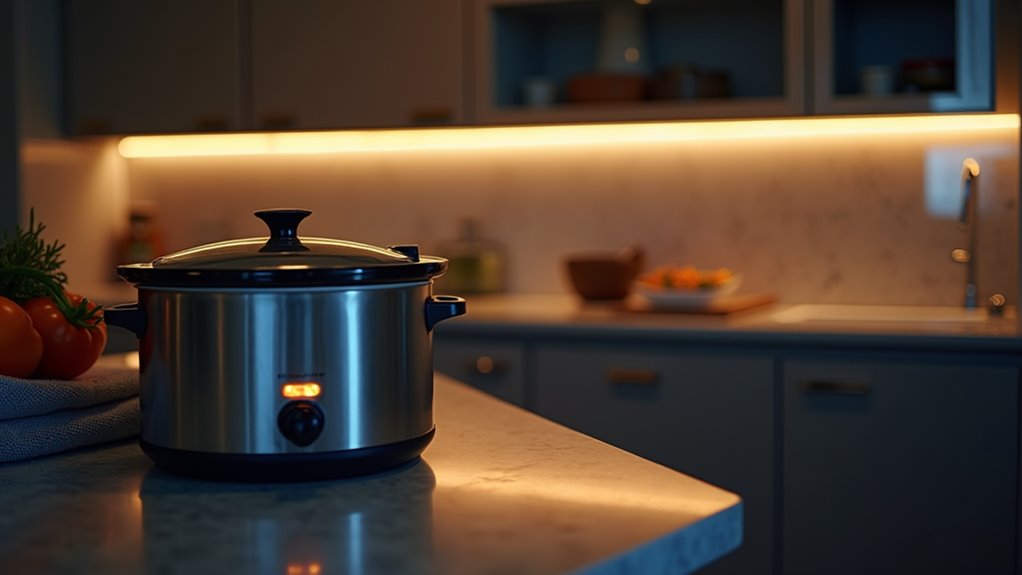
Yes — a slow cooker can safely run overnight when set up correctly. Use a steady Low setting and place the cooker on a flat, heat-resistant surface. Keep the lid closed to retain temperature and prevent evaporation. Check that the cord and plug are intact and positioned away from spills. Confirm the recipe and appliance manufacturer guidelines allow extended cooking times.
Can You Leave a Slow Cooker On Overnight?
Yes, you can usually leave a slow cooker on overnight, and for many people that’s one of the best things about it.
You can relax while dinner cooks, because most models are made for unattended use. For overnight monitoring, set it on low, since that setting is usually safe for about 8 hours.
Keep appliance placement smart: use a flat, hard, heat-resistant surface, and keep it at least 6 inches from walls, curtains, and other flammable items. Also, tuck the cord away from water and heat.
Secure the lid so steam stays inside, and check your manual for model-specific guidance. Should your cooker be old or have a frayed cord, replace it.
That way, you can feel at ease and stay part of the cozy meal magic.
How Long Can a Slow Cooker Run Safely?
A slow cooker can run safely for a good stretch of time, but the exact limit depends on the setting and the model you use. You usually get about 8 hours on Low or 4 hours on High, and many families rely on that rhythm for easy meals. | Setting | Typical Safe Time | Best Note |
| — | — | — |
|---|---|---|
| Low | 8 hours | Common for all-day cooking |
| High | 4 hours | Use for shorter meals |
| Warm | 4 to 6 hours | Quality might slip |
If your cooker has a timer, it could switch modes on its own. Check the manual, because appliance maintenance and thermal insulation matter too. Older units, frayed cords, or damaged seals need attention fast. Whenever you extend cooking, stay on Low, keep the lid on, and use a thermometer so your food stays above 140°F.
What’s the Safest Surface for a Slow Cooker?
You should set your slow cooker on a flat, hard, heat-safe surface like granite, tile, or a metal trivet.
These surfaces help prevent warping, scorching, and other damage that can happen during a long cook.
In case your counter needs extra protection, use a silicone mat or heat-proof pad, and keep the cooker away from edges, walls, and flammable items.
Flat, Hard Surfaces
The safest spot for your slow cooker is a flat, hard, non-combustible surface like granite, tile, or a metal trivet, since that gives it steady support and helps it stay cool around the base. You’ll feel better realizing it isn’t wobbling or sinking into soft spots.
Keep vent clearance at least 6 inches from walls and other appliances so heat can spread out safely. Skip carpets, towels, and placemats, since they can trap warmth and block airflow.
Should you’re unsure about your counter, use a heat-resistant pad and check that the cooker sits level. That small step helps prevent spills and keeps dinner on track.
Also, route the cord away from edges and water, and never let it touch the hot base. With a little granite maintenance, you’ve got a safer setup.
Heat-Safe Countertops
Once your slow cooker is steady on a flat surface, the next thing to check is what that surface can handle. You’ll feel better choosing granite, quartz, ceramic tile, or stainless steel, since these non-combustible tops resist heat and protect material longevity. In case you’re unsure, do simple countertop testing initially, because a little checking now can save a big headache later.
Skip wood and laminate, since the cooker’s base can scorch, discolor, or loosen them over time. Give the cooker at least 6 inches of space from walls and appliances so heat can escape. Should your surface feel risky, set a heat-proof trivet, silicone mat, or thick cutting board underneath. Also, keep cords dry, clear, and stable so dinner stays cozy, not chaotic.
Which Slow Cooker Settings Work Overnight?
For overnight cooking, you’ll usually want to use the low setting because it’s built to run safely for about 8 hours without drying out your meal.
You can use high only for shorter stretches, since it might overcook food or boil off too much liquid come morning.
Warm can hold food at a safe temperature, but it’s better for a few hours than for the whole night, so check your model’s timer and employ a thermometer should you be unsure.
Low Setting Overnight
In case you’re planning to leave a slow cooker on overnight, the low setting is usually the safest choice because it keeps food at a steady, gentle heat without pushing it too hard.
You get better overnight safety whenever you choose recipes made for gradual simmering, like stew or braise, instead of quick dishes that need more attention.
Most models hold this setting around 175°F and work well for about 6 to 8 hours, which fits many overnight meals.
Before you head out, make sure the cooker sits on a flat, heat-resistant surface, with space from walls and anything flammable.
Also, check that the cord looks good and that your model has a warm or off timer.
That little check helps you feel more at ease.
High Setting Limits
Although the high setting can help food heat up faster, it usually isn’t the right choice for an overnight cook. You want steady heat, not a rush job. High is built for about 3 to 4 hours, and after 4 to 6 hours, you might get dry meat, thin sauce, and a weaker texture. Should your cooker have safety timers, read the manual before trusting an auto-switch.
| Setting | Best Time | Overnight Use |
|---|---|---|
| High | 3-4 hrs | No |
| Low | Up to 8 hrs | Yes |
| High then warm | Timed | Only with care |
High also raises power draw, so older units and frayed cords deserve extra caution. In case you need the meal waiting for you, low usually fits your night better, and your kitchen crew can rest easier too.
Warm Mode Caution
Warm mode can seem like a safe middle ground, but it comes with a few catches you should know before you leave dinner running all night. It holds food at 140°F or higher, so it stays food-safe, but it isn’t built for endless hours.
Most kitchens suggest using it for about 4 to 6 hours, since longer warming can dry out meat, turn vegetables soft, and shrink the liquid. Before you trust it overnight, check your model’s manual, because sensors and timers might change from Cook to Warm on their own.
Also confirm thermostat calibration, keep the lid shut, and make sure appliance ventilation is clear. Then place the cooker on a hard, heat-resistant surface, with the cord and unit in good shape and away from flammables.
How to Keep a Slow Cooker Safe Overnight
To keep a slow cooker safe overnight, start with the low setting and make sure your meal has enough time to cook without running far past the needed window. Place it on a flat, hard, heat-resistant surface, then keep it away from walls, curtains, and anything that can burn. Check the cord for frays, and route it so no one can trip or tug it. Good kitchen ventilation helps keep the room comfortable, while child supervision keeps curious hands away.
| Safe step | Why it helps | Your payoff |
|---|---|---|
| Low setting | Stays steady | More peace |
| Clear space | Cuts risk | Less worry |
| Fray check | Protects power | Safer sleep |
| Programmable model | Switches smartly | Easier rest |
If you use warm mode, plan to serve food within 4 to 6 hours.
What Can Go Wrong If You Cook Overnight?
Even though a slow cooker feels harmless, leaving it on overnight could still cause a few real problems. You can come back to dry meat, mushy vegetables, and sauce that’s lost its fresh taste. After about 6 hours on warm, food quality often drops fast. Should the liquid cook down too much, the food can stick, scorch, and pick up a burnt flavor that no one wants at the table.
You also face electric hazards in case an older unit has a frayed cord or a faulty thermostat. Overflow can spill onto the cord or base, which adds more risk. Even whenever the heat stays safe, aroma diffusion might fade, so your home won’t smell as inviting the next morning.
Which Recipes Work Best Overnight?
Provided your cooker is going to run through the night, the best recipes are the ones that can handle time without falling apart. You’ll feel safest with hearty stews, chilis, and soups, because their liquid ratios stay steady and keep food from drying out.
Tough cuts like beef chuck, pork shoulder, and lamb shanks also shine overnight. Slow heat breaks down the fibers, so you wake up to meat that feels rich and tender.
Should you want grains or legumes, choose recipes made for long cooking, or use soaked pulses, so they don’t turn mushy. On the other hand, skip delicate vegetables, seafood, and dairy-heavy sauces, since they don’t hold up well.
Whenever you pick the right dish, overnight cooking feels easy and comforting.
How Long Can Food Stay on Warm?
Once your slow cooker switches to warm, it can usually keep food safe at 140°F or higher, which helps stop bacterial growth.
You could leave it there for a few hours, but food quality starts slipping after about 4 to 6 hours. That’s when texture degradation shows up, and sauces may thicken too much while meat dries out.
You might also notice flavor concentration, which can make some dishes taste stronger, but not always better.
To keep your meal feeling fresh and welcome at the table, leave the lid on, stir now and then, and add delicate herbs or greens right before serving.
Check your model’s manual too, because some cookers switch off warm after a set time. Use a thermometer should you be unsure.
When Should You Replace a Slow Cooker?
As useful as a slow cooker can be, it won’t last forever, and grasping at what point to replace it can keep your meals safer and your kitchen calmer. You should plan on a new one every 5 to 10 years, and sooner provided it acts up. Upon noticing a frayed cord, cracked lid, warped insert, or a locking part that no longer fits, don’t wait.
- In case it won’t hold low or warm temperatures, replace it.
- In the event food cooks much slower than before, upgrade it.
- In the event the model is old and nonprogrammable, a newer one can auto switch to warm or off.
- In case damage shows up, use appliance recycling and check manufacturer warranties for your next step.
Frequently Asked Questions
Is 24 Hours Too Long to Slow Cook?
Yes, 24 hours is usually too long for slow cooking. You risk food safety issues, muted flavor development, and drying out. You’re better off using a timed cooker, checking liquid, and stopping around 8 to 12 hours.
Is It Okay to Leave a Slow Cooker on and Leave the House?
Yes, you can leave your slow cooker on and leave the house provided you follow manufacturer directions, use low heat, and place it safely. That supports energy safety and unattended cooking for your household.