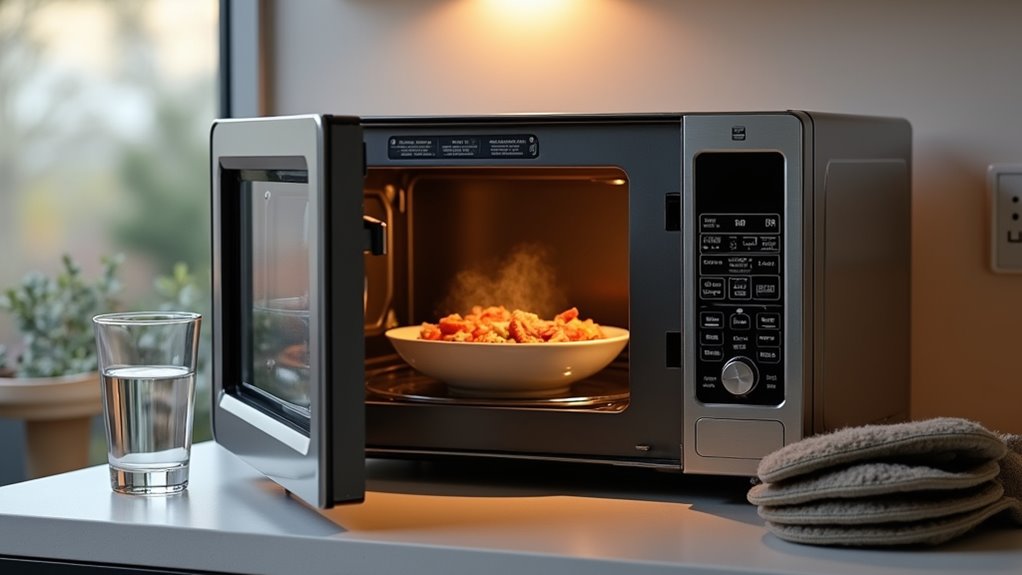
Microwave wattage directly affects how food heats, with higher watts producing stronger heat and faster cooking. Higher-watt units reduce cold spots in dense dishes and shorten reheating times for leftovers and frozen meals. Lower-watt models require longer cook times and occasional stirring or rotation to prevent uneven heating. Knowing your oven’s wattage lets you adjust times accurately for better results. This simple fact improves everyday cooking and reduces ruined meals.
What Microwave Wattage Means
Microwave wattage tells you how much cooking power your microwave can actually put out, and that number matters more than most people reckon.
You’ll usually see it between 600 and 1,200 watts in home models. Higher wattage means stronger energy that heats food faster, so a 1,000 watt unit works differently from a 700 watt one.
That difference affects microwave efficiency and your energy consumption, too, because you can match the right oven to your routine. Wattage also helps you read cook times with more confidence, since many meals use about 1,000 watts as the guide.
Whenever you check the spec plate, manual, or model number online, you’re really learning how your microwave fits your kitchen and your pace.
Why Microwave Wattage Affects Cooking Speed
A faster microwave does more than save a few minutes. It gives you more energy per second, so your food warms sooner and you spend less time waiting at the counter.
Whenever wattage climbs from 600 to 1,200 watts, the magnetron pushes stronger electromagnetic energy into the food, and water molecules respond faster. That speeds up heating kinetics and shortens both cooking and reheating times.
You’ll also notice how power settings work. Half power on a 1,200 watt oven still sends 600 watts, while half power on an 800 watt unit sends only 400 watts.
How Microwave Wattage Changes Heating Consistency
If you use a higher-wattage microwave, it pushes heat through food more strongly, so you get fewer cold spots and a more even result.
Lower-wattage models can leave dense foods patchy, which means you might need to stir or rotate them to help the heat spread.
Even at the same power setting, a bigger-wattage microwave still delivers more actual energy, so your leftovers usually heat more evenly.
Heat Distribution
Because wattage shapes how hard a microwave pushes energy into your food, it also changes how evenly that food heats. Whenever you choose a higher setting, you’re helping magnetron efficiency work with cavity shape, antenna placement, and field mapping to spread heat more smoothly.
That matters in a big casserole or a thick stew, where lower-wattage units can leave the center behind whilst the edges race ahead. You’ll also notice that 50% power on a 1,200 W oven still sends more energy than 50% on an 800 W model, so the food warms with steadier balance.
In larger cavities, this extra output helps you feel confident, because your meal comes out closer to the same temperature in every bite, and that’s a small win that feels good.
Reducing Cold Spots
Higher wattage doesn’t just cook food faster, it also helps cut down on those annoying cold spots that make a casserole feel half done in the middle.
Whenever you use a 900 to 1000 watt microwave, you get stronger, steadier energy, so dense dishes heat more evenly.
In your kitchen, that means less guessing and more trust in the meal you serve.
- Shorter heating keeps moisture from drifting away.
- Large cavities need enough power to stay balanced.
- Lower wattage often asks for stirring or rotating.
- Microwave placement and humidity control can support even results.
Also, keep in mind that 50% power means something different on each machine.
How Wattage Affects Food Quality
Crank up the wattage, and your microwave starts changing food fast in ways you can taste. Whenever you cook at 1,000 to 1,200 watts, you heat meals faster, so meats stay juicier and grains hold more moisture. That speed supports texture preservation and flavor retention, which helps your food feel closer to what you wanted in the beginning.
Stronger power also spreads heat more evenly through casseroles and rice, so you’re less likely to bite into a chilly center. Lower wattage can still work, but it takes longer and might dry food out. Should you use the same power percentage on different microwaves, the results won’t match. Many frozen meals expect about 1,000 watts, so matching the setting helps you fit in with better results.
Microwave Wattage for Leftovers
For leftovers, you’ll usually get the best results with a microwave around 900 to 1,000 watts because it heats faster and more evenly, so your meal doesn’t come out with a cold middle and a scorching edge.
Should your microwave be weaker, you can still reheat well through adding time, stirring or rotating halfway, and using medium power for dishes like casseroles, meats, and sauces.
For soups, coffee, and other liquids, heat in short bursts, then check the temperature and let the food stand a minute or two so the heat can settle through.
Best Wattage for Leftovers
A microwave around 900 to 1,000 watts is usually the sweet spot for leftovers, because it reheats food fast without turning the edges into rubber while the center stays cold.
You’ll feel more confident with dinner whenever your microwave matches your portion sizes and container materials.
For most meals, a 1 to 2 cup serving heats in about 1 to 2 minutes at 1,000 watts.
Should yours run lower, expect more time.
- Pick 900 to 1,000 watts for everyday reheating.
- Use 50% to 70% power for dense or saucy food.
- Adjust time assuming your microwave is 800 or 1,100 watts.
- Match the dish to safe, microwave-friendly container materials.
That way, you stay in control and keep your leftovers friendly, warm, and ready for you.
Reheating Evenness and Speed
Once you’ve already picked a good wattage for leftovers, the next thing to watch is how evenly that power spreads through the food. Higher wattage, around 900 to 1,200 W, can warm casseroles and rice faster, with fewer cold spots and better moisture retention in meats and sauces. That’s why many reheating protocols assume about 1,000 W. Should your microwave runs lower, you might need more time and a quick stir or turn to help the center catch up.
| Wattage | What You Notice | Best Move |
|---|---|---|
| 1200 W | Fast, even heat | Employ shorter cycles |
| 1000 W | Standard fit | Follow package directions |
| 800 W | Slower center heat | Stir midway |
| 600 W | More uneven spots | Rotate the dish |
| Mixed power | Different results | Match time to your oven |
When you know this, you feel more in control.
Adjusting Time for Meals
Matching microwave time to your oven’s wattage can save leftovers from turning dry, rubbery, or oddly cold in the middle. You belong in the group that gets dinner right, and timing adjustments help you do that.
- For an 800 W microwave, add about 25% more time.
- For a 1,200 W microwave, cut recipe time by about 17%.
- For casseroles or rice, stir and rotate halfway through.
- For sauces and meats, use 50% to 70% power, then finish with short bursts.
When you scale portions, add 30 to 60 seconds for each 100 to 200 g in a lower-watt unit. Should you’re unsure, reheat in 30 to 60 second bursts, check the center, and observe the total time. That way, your next meal feels easier and more familiar.
Microwave Wattage for Frozen Meals
Frozen meals can turn out great provided you match the microwave’s power to the package instructions. You’ll get better frozen textures whenever you respect the wattage guide, and that helps your meal feel like part of the table, not a solo act.
Most recipes assume about 1,000 watts, so should your microwave run at 700 to 800 watts, add 25 to 40 percent more time. In case yours is stronger, it’ll cook faster and cut down on cold spots in casseroles and stuffed entrées.
Whenever your oven is weaker, defrost initially or stir and stand the food halfway through. Check separate package directions, then use the lower-wattage timing and aim for 165°F.
For seasonal adjustments, smaller units suit single servings, while families do best with 1,000 watts or more.
Microwave Wattage for Drinks and Soup
For drinks, an 800 to 1,000 watt microwave usually gives you quick heat without too much guesswork.
With soup, that same range helps you warm it fast, and you can stop before it boils over and makes a mess.
Should your microwave runs hotter, just use shorter bursts and stir halfway so the heat spreads more evenly.
Quick Drink Reheating
A good microwave can warm your drink and soup fast, but the wattage makes a big difference in how smooth that job feels.
In a quick speed comparison, a 1,000 W model often finishes a cup in about a minute, while 600 to 800 W units need much longer. You’ll feel the difference, and that’s okay.
- Pick a container material that heats safely and evenly.
- Use 50 to 70% power for milk or coffee.
- Stir once so the warmth spreads.
- Check the cup often to avoid scalding.
If you operate a 700 to 800 W microwave, give it extra time.
In case you’re using a 1,100 W unit, shorten the heat and watch closely.
Small tweaks help you fit in with the rhythm of a busy kitchen, without stress.
Soup Heating Speed
Soup heats a little differently than a drink, and microwave wattage plays a bigger role here because thickness changes everything.
Whenever you warm a 1,000 W microwave, a 1-cup bowl can reach serving temperature in about 1 to 1.5 minutes.
Whenever you warm a 1,000 W microwave, a 1-cup bowl can reach serving temperature in about 1 to 1.5 minutes.
An 800 W oven usually needs closer to 1.5 to 2 minutes.
Because soup can hide cold spots, higher wattage helps you get more even heat with less microwave stirring.
For dense stews, you still should pause and check the center.
Provided you use 600 to 800 W, add 25% to 50% more time and stir every 30 to 45 seconds.
You want the soup to hit 165°F, or a rolling hot boil, so everyone at the table gets a safe, cozy bowl.
Common Microwave Wattage Ranges
Most household microwaves fall into a few familiar wattage ranges, and once you know them, choosing the right one feels much less confusing.
You’ll usually see 600 to 1,200 watts, and that spread gives you real options without making kitchen life feel like homework.
- Compact models often sit at 600 to 800 watts, which can suit small spaces and energy efficiency.
- Many countertop units land around 800 to 1,000 watts, a comfortable middle ground.
- Mid-to-large microwaves often reach 900 to 1,200+ watts for quicker, steadier heating.
- Some premium combos go above 1,200 watts for extra cooking modes.
If you want a familiar recipe match, 1,000 watts is the common reference point.
That way, you can pick a microwave that fits your routine and your crew.
What Counts As a High-Watt Microwave?
A high-watt microwave usually starts around 900 watts, and 1,000 watts is a great target should you want more flexible cooking.
You’ll notice that 1,000 to 1,200+ watts heats food faster, handles dense meals better, and gives you more even results than lower-power models.
To choose the right one, check the wattage on the spec plate or in the manual, since that number shapes both power settings and cook times.
Typical Wattage Ranges
At the time you look at microwave wattage, you’ll usually see residential models fall between about 600 watts and 1,200 watts, with many countertop units sitting near 800 to 1,100 watts.
That range helps you compare machines without guesswork, and it also supports energy efficiency and voltage compatibility in your kitchen setup.
- Under 800 watts, you’re usually in lower-power territory.
- Around 900 watts, you start entering high-watt range.
- 1,000 watts often acts like the everyday standard.
- Above 1,200 watts, you’re often looking at built-in or commercial-style units.
High-Watt Performance Benefits
In case you’ve been comparing microwave sizes and power levels, the next thing to know is how those extra watts actually change day-to-day cooking.
A microwave at 900 to 1,000 watts counts as high wattage, and 1,000 watts is the sweet spot for most kitchens. You’ll notice real efficiency gains because drinks, leftovers, and frozen meals finish faster, often by 25 to 50 percent. That speed also helps you feel less stuck waiting for dinner. Just as crucial, stronger power spreads heat more evenly through casseroles, rice, and other dense foods, so you get fewer cold spots.
Many larger ovens run at 1,100 to 1,500 watts, and that power supports accessory compatibility for convection, broil, air-fry, or steam features without slowing you down.
Choosing The Right Power
Choosing the right microwave power starts with grasping what “high watt” really means, because the number on the label changes how your food cooks every day.
You’ll usually find high-watt models at 1,000 watts or more, and they can save time while still fitting family meals.
That extra strength helps you feel more confident in the kitchen.
- 900 to 1,200 watts cooks faster than 700 to 900 watt units.
- A 1,000 watt microwave can cook 25 to 40% faster than an 800 watt one.
- Higher wattage heats casseroles and rice more evenly.
- Bigger cavities often need 1,100 watts or more for good energy efficiency and smart kitchen placement.
When you switch models, adjust recipes carefully.
Power settings are percentages, so 50% means different heat on different machines.
How To Check Your Microwave’s Wattage?
Start initially checking the easiest clue initially: your microwave’s own label. Open the door and look at the interior, or check the serial plate on the back or side.
For wattage verification, scan the label locations for an output line like “Output: 800W.” Then note the model number and visit the maker’s website or your manual for the exact rating.
In case you still feel unsure, call customer support with the model and serial number. They can confirm it fast, and you won’t have to guess.
Should you’ve kept the manual or box, check the specifications or technical data.
Most home units sit around 600 to 1,200 watts.
For a quick real-world check, time 1 cup of water. A 1,000-watt microwave usually boils it in 1 to 2 minutes.
How Microwave Size Affects Wattage Needs
A microwave’s size does more than decide how much fits inside, because it also shapes how much power you need to cook food evenly.
Whenever you use a bigger cavity, you usually need 1,000 to 1,500+ watts so heat reaches every corner and skips fewer cold spots.
- A compact 600 to 800 watt model works well for reheating and small plates.
- A medium 900 to 1,100 watt oven fits most family meals.
- Bigger dishes need stronger output to protect cooking time estimates.
- Good cavity acoustics and smart distribution help, but wattage still matters.
If you upgrade, match wattage to the cavity size.
That choice supports steady results and can ease strain on magnetron lifespan, so you feel confident every time you press start.
Built-In vs Countertop Microwave Wattage
Built-in and countertop microwaves can look similar at initial glance, but their wattage tells a different story.
You’ll often find built-in units at 1,000 to 1,500+ watts, while countertop models usually land between 600 and 1,200 watts. That extra power helps you heat larger dishes more evenly, so dinner feels less like a gamble and more like a win.
In case you share a kitchen, built-ins often support stronger features like convection or grill modes, while many lower-watt countertop models stay best for simple reheating.
Still, installation considerations matter, because built-ins need a snug fit and specific ventilation requirements to work safely. Whenever you swap between them, adjust time and power, since 800 watts and 1,200 watts don’t behave the same.
Choosing the Right Wattage for Your Home
Whenever selecting a microwave for your home, wattage is one of the easiest ways to narrow the field and avoid regret later.
In case you mainly reheat meals or follow standard recipes, you’ll feel right at home with about 1,000 watts. For a smaller household, 700 to 900 watts can fit your kitchen layout and save power when you don’t use it often.
- 1,000 watts suits most everyday cooking
- 600 to 800 watts needs longer cook times
- 1,000 to 1,200+ watts helps with bigger dishes
- Check the door, plate, or manual for the rated wattage
You should also match size to your user preferences. A larger cavity often needs more wattage to heat evenly, so choose a model that fits both your habits and the space you share.
Using Power Levels for Better Results
Because microwave power levels are really just percentages of the oven’s full strength, the same setting can act very differently from one machine to another. So whenever you cook, consider in percents, not just numbers.
Use 20 to 30 percent for gentle defrosting or softening butter, since low heat helps the center thaw without cooking the edges. Then move to 50 to 70 percent for soups, casseroles, and dense leftovers, where even heating matters most.
For quick boiling or a single portion, 80 to 100 percent works best, but shorten the time on a stronger microwave. In case you switch from a 1000 watt model to an 800 watt one, add about 25 percent more time.
That way, you’ll feel confident in any kitchen.
Frequently Asked Questions
Does Microwave Wattage Affect Cooking Time?
Yes, microwave wattage changes your cooking time. Higher wattage cooks faster, while lower wattage needs longer. You will want to adjust power levels to protect food texture and avoid cold spots.
Is a 900W Microwave Better Than 800W?
Yes, a 900W microwave is usually better, and you will not lose out on energy efficiency. You will get quicker, more even cooking, plus better food texture. If you just reheat leftovers, though, an 800W unit is still fine.