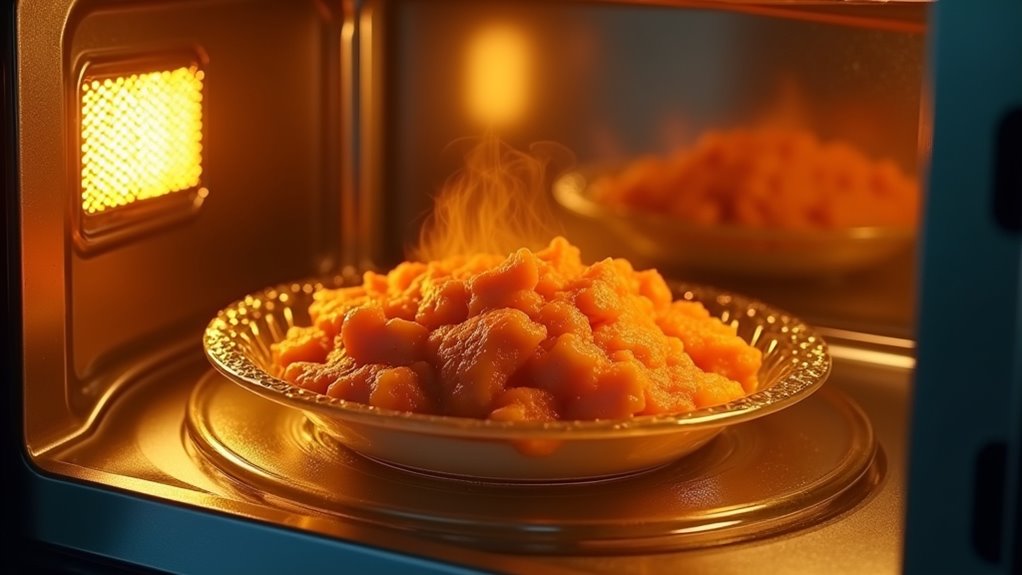
Microwaves heat food by making polar molecules, mainly water, rotate rapidly and generate thermal energy through friction. A magnetron produces 2.45 GHz electromagnetic waves that penetrate the cooking chamber and interact with those molecules. Energy absorption is uneven, so parts of the dish heat at different rates. Heat then spreads by conduction from hotter to cooler areas, finishing the warming process. This combination of electromagnetic heating and conduction explains hot spots and why stirring or resting food gives more even temperatures.
How a Microwave Oven Heats Food?
Upon pressing start on a microwave, a magnetron wakes up and sends out microwaves at about 2.45 GHz into the oven’s metal cavity. You feel the heat begin inside your food, not just on the surface, because those waves bounce around until the food takes them in.
With microwave penetration reaching about 1 to 1.5 inches, the energy works best in the outer zone. There, polarization effects make polar molecules turn and wobble, and that motion builds warmth fast. Foods with more water usually heat quicker, while drier parts need time and conduction to catch up.
Subsequently the oven cycles power on and off, so you get lower heat as required. Even after it stops, carryover cooking can add a few extra degrees.
Why Water Molecules Heat Up?
Water molecules are tiny dipoles, which means they’ve a positive end and a negative end.
In your microwave, the changing electric field makes those dipoles keep rotating back and forth to line up with it.
That quick motion creates friction between molecules, and that friction turns into heat.
Water Molecule Dipoles
Tiny electric dipoles are the reason a microwave can do its job so well. Water molecules aren’t evenly charged; their bent shape gives one side a slight negative pull and the other a slight positive pull. That natural split creates dipole alignment, which lets the oven’s changing field tug on each molecule. You can imagine it like tiny compass needles trying to face a moving signal.
In rotational spectroscopy, scientists study this same kind of motion because it reveals how molecules respond to energy. In your food, liquid water couples strongly with microwaves, while frozen water responds less. So you get faster heating in moist spots, and the warmth then spreads through nearby food. That’s why your meal starts waking up from the inside.
Rotating Dipoles Heat
Once those dipoles start lining up with the microwave’s changing field, they do more than just wiggle politely. You’re watching tiny water magnets chase a field that flips about 2.45 billion times a second. That nonstop push and pull drives rotational resonance, so each molecule keeps turning, then turning again. In that dance, dipole relaxation lets the motion lag behind the field, and the mismatch shows up as heat.
| Effect | What You Feel | Why It Matters |
|---|---|---|
| Field flip | Fast reorientation | Energy enters food |
| Dipole turn | Molecular motion | Heating starts |
| Relaxation | Lagging response | Heat builds |
| Penetration | Outer layer initially | Uneven warmth |
| Other polar parts | Slower absorption | Hot spots form |
You’re not alone in this process; nearby sugars and proteins join in, though water does most of the work.
Friction Creates Heat
As the microwave field flips back and forth, it pulls on each polar water molecule and makes it spin, wobble, and bump into its neighbors. You feel that action as molecular friction.
Because the field changes about 2.45 billion times each second, the molecules can’t settle down for long. They keep chasing the wave, and that chase creates rotational relaxation, where their motion lags behind the field.
As they collide, they pass energy into random motion, and that motion raises temperature. In your food, liquid water absorbs this energy better than ice, so soft spots warm faster.
Microwaves reach only the outer layer initially, about 1 to 1.5 inches deep, then the heat moves inward via conduction.
What Happens Inside the Oven Cavity?
Inside the oven cavity, the real heating work begins the moment the magnetron sends out microwaves at about 2.45 GHz. You’re not alone in this little metal room; the magnetic field, cavity modes, and surface currents all help shape where the energy goes.
- The walls reflect the waves, so they bounce around instead of escaping.
- The turntable or stirrer moves your food through changing hot and cool areas.
- The waves slip a little way into food and excite water, fats, and sugars.
That motion turns into heat, while thermal gradients start to shrink as warmth spreads.
Because microwave energy is non-ionizing, the oven air stays close to room temperature. And with door seals and interlocks working well, you stay protected while the cavity keeps energy where it belongs.
What Does the Magnetron Do?
The magnetron is the oven’s power maker, and it turns normal household electricity into the microwave energy that cooks your food.
Inside this small vacuum tube, heated electrons race under a magnetic field and create vacuum resonance in tiny cavities. That action builds about 2.45 GHz waves, which your oven uses for heating.
Next, antenna coupling sends those waves into a waveguide and then into the oven space. There, you and your meal get the benefit of a few hundred to about 1,200 watts of microwave power, depending on the model.
Upon the door opening, interlock switches cut power fast, so you stay safe. And whenever you choose a lower setting, the oven simply cycles the magnetron on and off for gentler heating.
Why Microwaves Cook Food Faster
Microwaves cook food faster because they don’t wait around to warm the air initially, and that’s a big deal whenever you’re hungry. They send energy straight into water, sugar, and fat molecules, so your food heats from the inside too.
That rapid penetration means the outer layers start warming at once, which trims cooking time and keeps you moving.
- Less waiting for hot air
- More energy efficiency
- Faster results at higher wattage
If your oven has more power, it pushes in more energy each minute, so your meal finishes sooner. Even on lower settings, it just cycles on and off, which slows the average heat.
Why Thick Foods Heat Unevenly
A thick casserole or roast doesn’t heat evenly in a microwave because the energy can only reach so far before the middle has to catch up on its own. You get hot edges initially, while the center lags, and that creates thermal gradients inside the food.
Since microwaves usually penetrate only about an inch or so, the outer layers absorb most of the heat. Then conduction has to do the rest, which takes time. Should your food be frozen in the middle, core stagnation can make cold spots even stronger because ice absorbs energy poorly.
Uneven shape, fat, and water also change how each area warms. So you help yourself through rotating, stirring, or letting the dish stand after cooking.
Microwave Safety Tips for Eggs, Liquids, and Dry Foods
When you microwave eggs, never leave them in their shells, because steam can build up fast and make them burst.
You should crack them into a microwave-safe dish, then pierce the yolk or scramble them so pressure has a way out.
For liquids, use a safe cup, heat in short bursts, and stir often, since superheated water can look calm and then erupt when you touch it.
Egg Shell Pressure
Eggs can turn risky fast in a microwave, because the shell traps steam and pressure builds until the egg can burst without warning. You can keep things calm by treating each egg like a tiny pressure vessel and protecting shell integrity.
- Crack eggs into a microwave-safe bowl initially.
- Pierce the yolk and white should you must heat them in a hurry.
- Cut a small vent in other foods with skins or membranes, too.
That small step helps steam escape, so you stay safer and avoid a messy pop.
In case you follow the time and power directions on the package, you lower pressure buildup even more. You’re not being fussy. You’re cooking smart, and your kitchen crew will thank you for it.
Superheated Liquid Risks
That same concealed pressure problem shows up with liquids and dry foods, too, and it can catch you off guard fast. You can keep things safer with simple superheat prevention. Stir liquids before and after heating, and use short bursts instead of one long run. Drop in a wooden stir stick or microwave-safe spoon, and use container venting by leaving a gap or covering loosely. Skip very smooth, clean cups when you can, because they make superheated drinks more likely. Also, never microwave whole eggs in shells or sealed foods; pierce yolks, and vent chestnuts or sausages.
For dry items, use low power, short times, and never run the oven empty. Whenever you reheat or defrost, rotate, stir, and let food stand so hot spots ease out together.
Which Containers Are Safe to Use?
Choosing the right container can take a lot of the stress out of microwave cooking. You’re safest with containers marked microwave-safe, since they handle heat without soaking up much energy. Try these trusted options:
- Heatproof glass, like Pyrex, and glass alternatives such as glass-ceramic.
- Microwave-safe plastics that pass the time-to-boil trial and stay cool.
- Plain paper towels, plates, or microwave-safe oven bags for brief heating.
Silicone containers can also work provided they’re labeled for microwave use. On the other hand, skip metal pans, foil, and dishes with metallic trim because they reflect waves and can spark. Also avoid thin plastics, foam cups, and old yogurt tubs, since they might soften or leach.
Whenever you choose well, you join a smarter, safer kitchen crowd.
Do Microwaves Leak or Cause Interference?
Even though you’ve picked a safe container, you could still question whether the microwave itself can emit energy or interfere with nearby gadgets. You can relax a bit: ovens use metal cavities and tight door seals to keep microwave leakage low. U.S. rules limit it to 5 mW/cm² at about 2 inches, and the signal drops fast as you step back. At around 20 inches, it’s near 1% of that close range reading. Still, check the door, hinges, and latch. Should they be bent or worn, don’t keep using it.
Because microwaves work near 2.4 GHz, you might notice wireless interference if shielding is poor or your device sits very close. Most well sealed ovens won’t bother your Wi-Fi. Were the door to open, interlocks should stop the wave.
Other Uses for Dielectric Heating
You’ll find dielectric heating doing more than warming food in your kitchen.
In factories, it can dry thick wood fast and help glue laminated wood and composites with strong, quick bonds.
It also speeds up food, textile, and paper processing through heating moisture-rich materials more evenly, so you get faster results without the long wait.
Wood Drying and Gluing
Beyond heating leftovers, dielectric heating also does some very practical work in shops and mills, especially whenever wood needs to dry fast or glue needs to set cleanly.
You can see it in action with 3 helpful uses:
- Microwave frequencies heat water inside timber, so thick boards dry from the inside out.
- In vacuum kilns, lower pressure helps moisture boil off sooner, which cuts damage and checking.
- In electrode bonding, RF energy warms the adhesive right where you need it, so joints cure fast without cooking the surrounding wood.
That means you get stronger laminates, cleaner joins, and less waiting around.
Whenever you work with dense lumber, this kind of selective heat can feel like having a careful teammate at the bench.
Food And Textile Processing
In factories, dielectric heating does more than warm food, and it often does that work with surprising care. You can use it to pasteurize foods fast, dry tea leaves, and protect delicate flavors because it heats water inside the material initially. That means shorter runs and less damage.
You’ll also see it in textiles, where microwave energy speeds drying and dye fixation through agitating polar molecules right in the fibers. As moisture migration moves inward and out, the cloth dries more evenly. For thicker products, 915 MHz reaches deeper, while 2.45 GHz fits thinner layers. So whether you’re helping a meal or a shirt finish on time, you get cleaner results, steadier quality, and a process that feels engineered for you.
Microwaves, Health, and Food Quality
Peace of mind matters whenever you heat a quick meal, and microwaves are generally safe for both you and your food.
You might hear worries about cellular damage, but normal ovens use nonionizing energy, so they don’t make food radioactive.
Consumer perceptions often shift once you know the heat comes from water molecules moving, not from burned-out nutrition.
Try this:
- Check the center with a thermometer.
- Let food stand about 3 minutes.
- Reheat poultry to 165°F and ground meat to 160°F.
Because microwaves warm only the outer inch or so, thick foods can hide cold spots where bacteria survive.
Still, you can trust the method whenever you stir, cover, and rest food.
Plus, quick cooking usually keeps more nutrients and brings you a meal that feels safe, simple, and yours.
Frequently Asked Questions
Why Do Some Foods Dry Out in the Microwave?
Because you dry out food’s moisture through water migration and starch retrogradation; you are not alone in this. Your microwave causes uneven heating, so surfaces lose water fast, leaving you with tougher, drier bites.
Can Microwaves Heat Food From the Inside Out?
No, you cannot heat food truly from the inside out. Microwaves penetrate food and heat water molecules, so outer layers and inner moisture warm together, producing more even, welcoming results.
Why Does Food Need Standing Time After Microwaving?
You need standing time because carryover cooking continues heating food gently, and moisture redistribution evens out hot spots. You’ll get better texture, safer bites, and a more even, satisfying meal together.
Why Do Microwaves Rarely Brown Food Like Ovens Do?
You rarely get browning because microwaves leave low moisture surfaces cooler, while ovens raise surface temperature through limited convection. That means enzyme activity and browning reactions stay weak, so your food will not develop that familiar crust.
What Causes Hot and Cold Spots in Microwaved Food?
You get hot and cold spots because wave interference and container geometry steer energy unevenly; it’s like two friends sharing one blanket. In one trial, rotating a bowl reduced temperature gaps, so you are not alone.