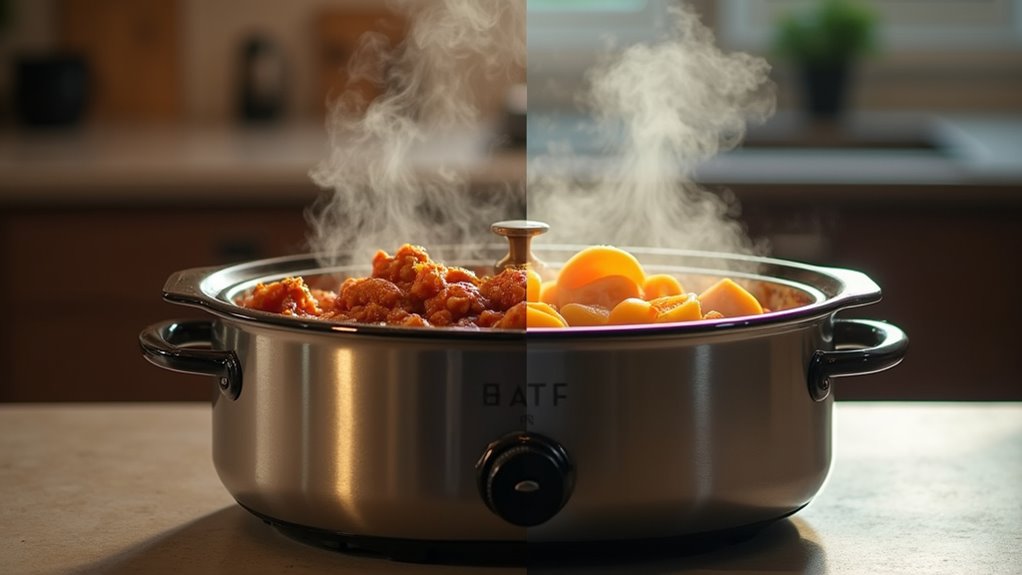
Low and High are more than simple labels on a slow cooker; they control how quickly food reaches safe cooking temperatures. Low heats gently over several hours for tender braises and stews. High brings contents up to temperature faster for quicker meals or when starting later in the day. The real difference is how long meat spends in the temperature range that breaks down connective tissue. Picking the right setting prevents dry roasts and saves time while delivering reliably tender results.
What Slow Cooker Low and High Really Mean
At the point you turn a slow cooker to Low or High, you’re mostly choosing how fast it heats, not two fixed cooking temperatures. Low and High shape the cooking rate, so Low warms food more gently and High gets you there sooner.
That’s why you might see label confusion across brands and models. One cooker’s Low can sit in the 160s, while another’s could climb closer to the 180s. High also varies, and some units run near 200 degrees or even a bit more.
For you, that means the setting name matters less than your own cooker’s behavior. Should you want steady results, do a simple water trial with a thermometer. Then you’ll know how your cooker really works, and you can cook with more confidence.
Why Slow Cookers Run at Different Temperatures
You’ll notice that slow cookers don’t all hold the same heat, even whenever you pick the same setting. That’s because brand design, shape, and how the heating parts sit inside the cooker can change the real temperature quite a bit.
Brand Temperature Differences
Even though two slow cookers share the same Low, High, or Warm label, they don’t always heat the same, and that can feel a little unfair as you’re just trying to make dinner.
You’re not imagining it. Brand consistency isn’t perfect, so model evaluation matters.
One oval Crock-Pot may sit near 185 to 187°F on Low, while a Hamilton Beach oval lands closer to 165 to 168°F.
Shape matters too, because a round pot can run cooler than an oval from the same brand.
Some Warm settings act like Low, but others cook almost like High.
Since no industry standard locks these settings in, you’ll feel more confident when you assess your own cooker with water or food. That way, you know what your pot really does.
Heat Settings Vary
Because slow cookers don’t follow one set heat rule, the same Low, High, or Warm label can mean very different things from one model to the next. That heat variability can feel annoying, but you’re not doing anything wrong.
- Low might run near 165°F in one cooker and 185°F in another.
- High often heats faster, not just hotter.
- Some High settings climb close to boiling.
- Warm can stay safe, or act almost like High.
When you know this, cooking consistency gets easier to understand. Your cooker’s personality matters, and yours is welcome here. A quick water trial with a thermometer helps you learn its true behavior. Then you can trust your own machine instead of guessing, and that confidence makes slow cooking feel a lot more friendly.
Recipe Results Shift
That’s where the real recipe shift starts to show up. Your slow cooker doesn’t just heat food one way, so your stew, roast, or chili can change a lot from one model to the next. A Low setting could sit near 165°F on one cooker, while another reaches closer to 187°F, and High can climb much faster toward boiling.
That means ingredient textures can stay firmer or turn softer sooner than you expect. Even Warm settings can surprise you, since some hold food safely and others act more like High. You’ll also notice that bigger or colder batches need timing adjustments.
Should you want reliable results, examine your cooker with water and a thermometer initially. Then you can match recipes to your own pot with confidence.
How to Test Your Slow Cooker at Home
Evaluating your slow cooker at home gives you real numbers, not guesses, so you can cook with more confidence and less worry.
For daily calibration, fill the insert with 1 to 2 inches of room-temperature water, set the lid on, and run Low for 1 1/2 to 2 hours. Measure away from the bottom and sides. Then switch to High, keep the same water, and wait 1 to 1 1/2 hours. Next, check Warm after 1 to 2 hours.
- Sample center and side spots
- Skip auto-timers unless possible
- Log your model and readings
- Re-evaluate whenever seasonal effects or age show up
Take quick readings, since small swings happen.
A 10 degree gap needs attention, but 2 to 3 degrees is normal.
What You Need for a Temperature Test
You don’t need a fancy setup to trial a slow cooker well, just the right few tools and a steady method. Grab a simple probe thermometer and a 5 to 7 quart insert.
Add 4 cups of room-temperature water, which gives you about 1 to 2 inches of depth and helps mimic food heating. Next, care about probe placement, because the tip should sit in the center or near a side without touching the ceramic bottom or walls. That keeps your readings honest.
Since ambient humidity can shift kitchen conditions a little, record it with your observations. Then label each cooker, write down the setting, start water temperature, elapsed time, and every reading. Those details help you compare models with confidence.
How to Set Up the Water Test
At the start of the water trial, set the slow cooker up as close to real cooking as possible. Pour in 4 cups of room-temperature water, about 1 to 2 inches deep, for a 5 to 7 quart insert. That amount gives you a fair heat load, and it keeps the experiment friendly and realistic. Use these placement tips so your reading feels solid:
- Set the lid on loosely, not clamped.
- Place the cooker on a stable counter.
- Keep the probe off the crock bottom and sides.
- Try water alternatives only when you need a matching fill level.
Then let it run on Low for 1.5 to 2 hours.
For High, warm it on Low first, switch to High, and give it 1 to 1.5 more hours.
How to Take an Accurate Temperature Reading
Once your slow cooker has run long enough to settle in, the next step is to check the heat the right way so the reading means something.
Use a probe or instant-read thermometer and mind your probe placement. Push it 1 to 2 inches into the water or food, but don’t let it touch the ceramic bottom or sides, or you might get a false spike.
Keep the water depth at 1 to 2 inches, since that helps you measure liquid temperature instead of trapped air.
Then check several spots, including the center and near the side. Small changes of 2 to 3°F are normal, so you can relax a bit.
In the event you see about 10°F between spots, your cooker could heat unevenly.
Slow Cooker Low Temperature Results
Low setting results can feel a little mysterious at initially, but the numbers are actually pretty helpful once you know what to expect. Whenever you evaluate your slow cooker on Low, you’ll usually see about 165°F to 187°F, with many models landing in the 170s. That spread shows why water variability and probe placement matter so much.
- A Hamilton Beach oval could read near 165°F.
- An oval Crock-Pot can reach about 187°F.
- A round Crock-Pot often sits around 173°F to 175°F.
- Most units steady out after 1.5 to 2 hours.
Slow Cooker High Temperature Results
As soon as you switch your slow cooker to High, the heat climbs fast and the numbers get much more dramatic than on Low. You can see why this setting helps when you need dinner sooner.
In trials, a round Crock-Pot pushed water to a lively boil around 207 to 208°F in about 1½ to 2 hours. An oval Crock-Pot landed near 196 to 199°F, and a Hamilton Beach oval rose to about 202°F before settling near 196°F after the lid opened. So High can run close to boiling, which speeds cooking but can overdo tender foods should you not be watching.
For seasonal cooking, that extra power can be handy, but it could trade off some energy efficiency.
What the Warm Setting Should Do
When you switch your slow cooker to Warm, it should keep your food safely above the danger zone, usually around 140 to 170°F.
It shouldn’t keep climbing toward a boil, because Warm is meant to hold food, not keep cooking it.
In case your unit runs too hot, you might need to check the temperature so your roast doesn’t turn into a surprise science experiment.
Warm Keeps Food Safe
Keeping food safe on Warm starts with one simple rule: the cooker needs to stay above 140°F, or 60°C, so your food doesn’t slip into the bacterial danger zone. Whenever you use Warm for food safety, you’re really trusting its holding temps, not asking it to cook. A good setting keeps dishes ready without drying them out or pushing them farther along.
- Check your model with a probe thermometer.
- Aim for a stable 150 to 170°F whenever possible.
- Choose a cooker that fits holiday or buffet use.
- Skip Warm whenever it runs near 190 to 200°F.
That way, you can serve with confidence and feel like everyone at the table gets a safe, welcoming meal.
Warm Should Not Boil
Warm should never boil your food, because that setting is meant to hold a meal safely, not keep it cooking. Whenever you use Warm, you should expect steady heat above 140°F, often near 150 to 170°F, so dinner stays ready without turning tough or dry.
Should your pot starts simmering, you’re not seeing normal behavior. That usually points to thermostat failure or user misconceptions about what Warm can do.
On a well-made unit, the temperature stays fairly stable for hours, not jumping like Low or High. Still, models vary, so you should examine your slow cooker with a probe thermometer before trusting it for the whole afternoon.
Should Warm act like High, your food might keep cooking and lose the texture you wanted.
Which Slow Cooker Ran Hottest and Coolest?
Even in a simple kitchen trial, the three slow cookers didn’t act the same, and the differences were big enough to matter.
In this model comparison, you can see the temperature extremes clearly. The oval Crock-Pot ran hottest on Low, climbing to about 185 to 187°F. The round Crock-Pot stayed in the middle at roughly 173 to 175°F. The Hamilton Beach oval ran coolest, landing near 165 to 168°F. On High, the round Crock-Pot boiled the water at about 207 to 208°F. The oval Crock-Pot hit about 196 to 199°F, and the Hamilton Beach settled near 196°F. For Warm, the oval model behaved like High, while the Hamilton Beach held near 160 to 167°F, which feels steadier.
When to Use Low, High, or Warm
After you see how much slow cookers can vary, the next question is simple: which setting should you use and at what time? Use Low when you want a true low-and-slow cook.
It usually runs about 165 to 187°F, so it gives you 6 to 8 hours to build tender texture profiling for tough cuts and steady flavor. Use High when meal timing is tight.
It often reaches 196 to 208°F, so your dish can finish in 3 to 4 hours. Use Warm only after the food is done and you want to keep it ready for serving.
Some Warm settings act gently, while others stay much hotter. Should your cooker have a switch from High to Warm, trial it initially so your timing fits your cooker, not the box.
Slow Cooker Food Safety Tips
Slow cookers make dinner easier, but food safety still needs your attention. Start with fresh ingredients, not frozen ones, and handle them with clean hands and tools. Good ingredient handling helps your meal warm up fast enough to stay safe.
Keep warm foods above 140°F, and check your cooker with a probe thermometer to be sure the Warm setting really holds steady. Because models vary, do a quick water trial with 1 to 2 inches of room temp water and check it after 1.5 to 2 hours. That small step helps you plan reliable cooking times and safer storage practices later.
- Watch the temp
- Use fresh food
- Trial Warm mode
- Record your results
How to Choose the Right Slow Cooker
You want a slow cooker that matches how you cook, so compare Low and High heat before you buy. Should you need all-day gentle cooking, choose a model that runs cooler on Low, but in case you want faster tenderizing, pick one that runs hotter.
Also, match the cooker’s size and shape to your recipe so your roasts, stews, and soups heat evenly instead of leaving you with a stubborn cold center.
Slow Vs High Temperatures
Whenever you compare the Low and High settings, the biggest difference is speed, not just heat. Low usually keeps water around 160 to 190°F, so you get gentle cooking for 6 to 8 hours or more.
High often climbs near boiling, so your meal can finish in 3 to 5 hours. That shift changes how your kitchen feels too, with softer ambient flavors on Low and a quicker rhythm on High. You can also notice energy consumption should you use High often.
- Low helps you slow down together.
- High fits busier days.
- One cooker might run hotter than another.
- A probe thermometer keeps you sure.
Because settings vary by model, assess your unit before you trust the dial.
Match Cooker To Recipe
The right slow cooker can make a recipe feel easy instead of stressful, and the best choice starts with how hot your unit runs and how much food it holds.
Should you’re making low-and-slow meals, pick a cooler cooker so chicken, fish, or soft vegetables stay tender.
Should you need tougher beef or pork to soften faster, a hotter model can help.
Next, ponder about portion planning, because a bigger pot only works well when you fill it enough to heat through on time.
After that, use timing adjustments to fit your schedule and your recipe.
Should you want to leave dinner safely on Warm, choose a programmable unit with steady keep-warm performance.
Finally, trial your cooker with water and a thermometer, then jot down the temps for repeatable results.
Frequently Asked Questions
Is It Better to Use Low or High Settings on a Slow Cooker?
You’ll usually get better results on low, like a slow sunrise warming your meal, because it enhances flavor development and food safety. Use high whenever you’re rushed, then check doneness with a thermometer.