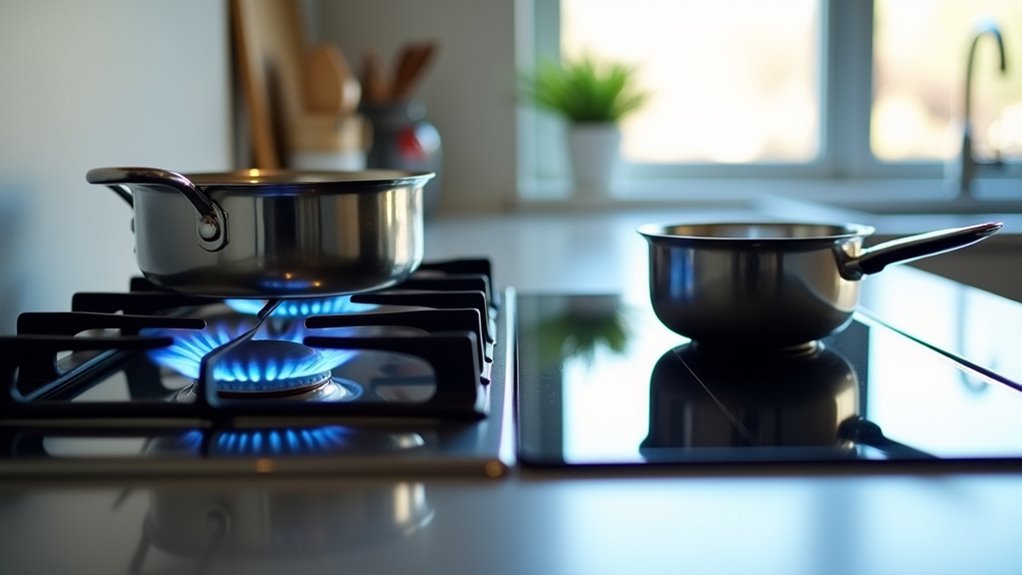
Yes — induction cooktops use significantly less energy than gas stoves. Induction transfers electricity directly into magnetic cookware, so most energy heats the pan rather than the air. Gas burners lose a large portion of heat around the flame and burner assembly. That efficiency gives faster cooking, lower utility bills, and less excess kitchen heat. Tradeoffs include cookware compatibility, upfront cost, and occasional electrical constraints.
What Is an Induction Cooktop?
So, what exactly is an induction cooktop? You’re looking at a smooth glass-ceramic surface with an electromagnetic mechanism under it.
Whenever you set magnetic cookware on top, the coil wakes up the pan itself, and heat forms right in the metal. That’s why the cooktop stays cooler than you could expect.
This setup can feel like a smart fit for your kitchen because it gives you fast, precise control and wastes less energy.
You’ll also notice cookware compatibility matters here. A magnet should stick to the base, and flat-bottom pots usually work best.
Assuming you’ve ever wanted cooking that feels quick, safe, and calm, induction can make you feel right at home while you prepare with confidence.
What Is a Gas Stove?
A gas stove works a bit differently from an induction cooktop, and that difference matters as you’re choosing what fits your kitchen best. You get heat by burning natural gas or propane, which creates an open flame under your pan. That gives you quick, visible control, so you can turn the flame up or down and feel the change right away.
Gas ranges also accept almost any cookware, from copper to glass and stoneware, which many cooks like for cultural preferences and family recipes.
In history origins, gas stoves became popular because they felt familiar and flexible. Still, they release indoor pollutants, need good ventilation, and bring safety concerns like leaks and burns. You might also notice extra warmth in the room, since much heat escapes into the air.
Why Induction Uses Less Energy
The quiet edge of induction starts with how it puts heat where you need it most: right in the pan. With magnetic coupling, the cooktop sends energy into ferrous cookware instead of warming the room, so you waste less and feel more in control.
| Factor | Induction | Gas |
|---|---|---|
| Heat path | Pan initially | Air initially |
| Cookware fit | Tight match | Loose flame spread |
| Energy loss | Low | High |
That focus helps you cook faster and keep heat steady with less overshoot. Should your pan have a flat, magnetic base, the connection stays strong and the savings improve. Even during moments you ponder grid power, induction can still lower lifecycle emissions because it uses less energy at the stove. So you get a cleaner, calmer kitchen that feels built for you.
How Efficient Is Induction vs Gas?
Whenever you compare the two side by side, induction usually comes out far ahead because it turns about 84 to 90% of its input energy into heat inside the cookware, whereas gas uses only about 40%. That stronger energy conversion means you get more useful heat with less wasted power, and you’ll notice the difference whenever dinner needs to happen fast.
- You boil water quicker, often 20 to 40% faster.
- You keep your kitchen cooler and more comfortable.
- You often spend less on energy over time.
- You might lower lifecycle emissions, especially with cleaner electricity.
- You get better pan matching, so heat goes where you need it.
If you want efficiency that fits real life, induction gives you a strong, practical edge without asking you to change everything.
Why Gas Stoves Waste More Heat
Gas stoves often waste more heat than you could expect, and that can make cooking feel less efficient than it should. Whenever you light a burner, only about 40% of the fuel’s energy reaches your pan. The rest warms the air, grates, and nearby surfaces, which can affect thermal comfort and your kitchen design choices.
| Heat source | Goes to food | Gets lost |
|---|---|---|
| Burner flame | 40% | 60% |
| Side flame spill | Low | High |
| Hot kitchen air | None | More |
If your pan is smaller than the flame, even more heat slips around the edges. So you might feel extra warmth, run the fan more, and still miss out on that cozy, efficient cooking vibe your home deserves. Gas also burns fuel at the stove, so each meal could leave a larger footprint.
Which Cooktop Cooks Faster?
At the outset you cook on induction, the pan heats directly, so you usually get boiling water and hot pans much faster than with gas.
In many trials, induction boils water about 20 to 40 percent quicker, which can save you real time on busy nights.
Gas still feels powerful, but for many everyday jobs, induction often gets you to the finish line initially.
Speed of Induction Heating
Induction cooktops usually heat up faster than gas, and you can feel that difference right away.
- You place the pan on the burner.
- Magnetic coupling sends heat straight into the cookware.
- Water starts moving sooner, often in a few seconds.
- The rapid response helps you shift from simmer to fry without waiting.
- Less heat escapes into your kitchen, so your meal stays on track.
Because induction pushes energy into the pot with about 84 to 90 percent efficiency, you waste less and cook sooner.
That speed can save you time on pasta, soup, or a quick sear, and it keeps dinner moving whenever you’re hungry and ready.
You get control, comfort, and a smoother rhythm at the stove.
Gas Boiling Time Comparison
Boiling water is where the difference between these two cooktops really starts to show. In case you’re waiting for dinner to begin, induction usually gets you there ahead. In many trials, it boils water 20 to 40 percent faster than gas, and that speed can feel even bigger when your pot fits the burner well.
Induction sends heat straight into flat-bottom cookware, so less energy slips away. Gas still works, but it loses more heat to the air around the pan. At seasonal altitude, both can slow down a bit, and water impurities might nudge timing too. Even so, induction typically recovers faster after you add cold ingredients, so you stay in control and keep the meal moving.
How Temperature Control Differs
Although both stoves can cook your food well, they handle heat in very different ways, and that changes how much control you feel at the burner. On induction, you get rapid response and true precision simmering, so your sauce can stay steady without drifting.
Many units even let you set exact degrees or use a probe, which feels reassuring whenever you want dinner to come out just right. With gas, you do get tactile feedback from the flame, and that familiar glow helps you judge the burner.
Still, heat changes are less exact, and low settings can wander.
- Induction heats the pan directly.
- It can hold a set temperature.
- Gas gives a visual flame cue.
- Gas feels less consistent at low heat.
- Induction reacts with very little lag.
Which Cooktop Is Safer Indoors?
Provided you cook indoors, induction usually feels safer because it skips open flames and keeps the cooktop cooler to the touch.
Gas stoves, on the other hand, can leave hot grates, open flames, and concealed combustion pollutants in your air. So as you compare them, it helps to consider about both burn risk and the air you breathe every day.
Induction Surface Safety
At the time you’re cooking indoors, safety matters just as much as speed, and induction usually has the edge here. You touch a cooler glass top, so you lower burn worries for child safety and pet protection. That calm matters whenever little hands or curious paws wander nearby.
- Heat forms in the pan, not on the cooktop.
- The surface cools fast after you lift the pot.
- Auto shutoff helps if no cookware sits there.
- No open flame means fewer contact burns.
- No combustion byproducts means cleaner indoor air.
Because you rely on electricity, you skip gas leaks and extra ventilation stress. So you can cook with more confidence, and your kitchen feels safer for everyone sharing the space.
Gas Flame Hazards
Whenever you compare indoor safety, gas stoves bring more hazards than most people realize, because their open flames and hot grates can quickly cause burns or start a fire.
You also face gas line leaks should fittings fail or age, which adds another layer of risk in a busy kitchen.
In contrast, induction removes the flame, keeps the surface cooler, and shuts off once you lift the pan, so you’re less likely to leave heat on accidentally. That matters whenever you’re cooking for family or sharing a small space, where everyone wants comfort and trust.
Your open flame psychology could still pull you toward gas, and cultural attachment patterns can feel strong, but safety often favors induction.
A venting hood helps either way.
Indoor Air Quality
Because cooking happens in the heart of your home, indoor air quality matters just as much as heat control, and this is where gas and induction differ in a big way. Gas stoves send nitrogen dioxide, carbon monoxide, formaldehyde, and fine particles into your kitchen, so the air can feel heavy fast.
- You might smell fumes after simmering.
- A vented hood helps with indoor ventilation.
- Kids with asthma can breathe easier with pollutant mitigation.
- Induction makes no combustion byproducts at the stove.
- Boiling water on induction usually releases less CO2.
How Each Affects Indoor Air Quality
Whenever you compare gas and induction, indoor air quality is one of the biggest differences you’ll notice. With gas, your kitchen can fill with nitrogen dioxide, carbon monoxide, and formaldehyde, so your pollutant exposure rises fast. Induction changes that image right away because it makes no combustion pollution at the burner.
| Stove type | Main emissions | Indoor effect |
|---|---|---|
| Gas | NO2, CO, HCHO | Raises exposure |
| Induction | None from fuel | Cuts exposure |
| Both | Cooking particles | Need ventilation |
Even so, food still gives off particles and VOCs, so ventilation effectiveness matters a lot. A vented hood helps pull pollutants outside and keeps the air more comfortable for everyone in your home. Should you switch from gas to induction, you’re joining a cleaner daily routine with fewer concealed fumes and less worry.
What Cookware Works on Induction?
Now that induction gives you cleaner air, the next question is simple: will your favorite pans actually work on it? You belong in the club provided you check initially, because induction only heats ferromagnetic cookware. Try magnetic testing with a fridge magnet; provided it sticks, you’re likely induction compatible.
- Cast iron usually works right away
- Many stainless steel pans do too
- Pure copper, aluminum, glass, and most ceramic pans won’t heat
- A ferrous disc or magnetic base layer can help some pans
- Flat bottoms and enough base thickness improve contact and steady heat
Thick, heavy pans often feel better for cookware care because they hold heat and stay stable. Provided your pan is warped or rounded, heating can get weak.
Also, some burners like pan sizes that match well, so a solid fit can cut buzzing and make cooking feel calmer, together.
Induction Vs Gas Cleaning and Maintenance
Whenever you compare cleaning, an induction cooktop usually feels easier because its flat glass-ceramic surface wipes clean fast after cooking.
With a gas stove, you have to work around grates, burners, and drip pans that catch grease and crumbs, so tough scrubbing often takes more time.
Since induction stays cooler and gas parts collect more mess, your cleanup routine can feel very different from one cooktop to the next.
Flat Surface, Easy Wipe
Induction makes cleanup feel almost effortless, because the smooth glass-ceramic top stays cooler around the pan and helps spills stay loose instead of baking on fast.
- You can use a damp cloth and finish in seconds.
- Your wipe technique feels simple and calm after cooking.
- Mild detergent helps without harsh effort.
- The flat surface supports better scratch resistance whenever you use compatible pans and soft pads.
- You still protect the top from heavy rough cookware.
Because heat stays in the cookware, you spend less time chasing sticky spots.
That means you can clean up, breathe out, and feel right at home in your kitchen.
Gas cooks well too, but its grates and crevices usually ask for more effort, which can slow your evening.
With induction, you get a neat surface that fits busy days and easy habits.
Grates, Burners, Tough Scrubbing
Those easy-wipe surfaces are a relief, but the story changes fast once you look at grates and burners. With induction, you usually just swipe away spills before they bake on, so you skip the tough scrubbing that gas often demands.
Gas grates and burner caps trap grease, crumbs, and sauce in little crevices, and you might need to soak, scrub, or use degreasers to get them clean. That extra work can also tie into ventilation needs, since more heat and soot spread through the kitchen.
Induction keeps the mess flatter and gentler, though you still want to avoid abrasive pads and rough dragging. A smart grate redesign could help gas feel easier, but for now, induction gives you a cleaner, calmer routine.
When Gas Stoves Still Make Sense
Even so, gas stoves can still be the smarter choice in some homes, especially should you cope with frequent power cuts or already have a cheap natural gas hookup. You get backup cooking whenever the grid fails, and that can steady dinner plans fast. Provided you cook with a visible flame, you might also like the control and the familiar feel of cultural preference.
- You keep cooking during outages.
- You might skip costly electrical upgrades.
- You can use open-flame methods with ease.
- You might keep your current cookware.
- You can save money whenever gas stays cheap.
For some families, that mix of reliability, comfort, and lower near-term cost feels like home. Assuming your kitchen already works well, gas can help you stay connected to the meals, routines, and people you care about.
How to Choose Between Induction and Gas
So how do you pick the one that fits your kitchen best? Start with how you cook, what you own, and what feels comfortable in your hands. Should you want fast boils, sharper temperature control, and less wasted energy, induction usually wins. It runs about 80 to 90% efficient, while gas sits near 40%, so your meals can move quicker. It also supports kitchen electrification, cleaner air, and better user ergonomics because the cooktop stays cooler.
Nevertheless, gas still suits you provided you use any cookware, love an open flame for charring, or need lower upfront costs. Next, check your electrical capacity, rebate options, and whether you can replace older pans. That way, you choose a setup that feels right for your home and your routine.
Frequently Asked Questions
How Much Does Installation Cost for Induction Versus Gas?
Installation costs for induction often run $200 to $1,000 or more, while gas can cost $100 to $800, depending on wiring, venting, and hookups. You’ll feel right at home choosing based on upfront expenses and your setup.
Can Induction Cooktops Work During a Power Outage?
No, you usually cannot cook during a blackout on induction alone, unless you have battery backup or portable stoves. You will feel better realizing your kitchen still has a welcoming fallback once the lights take a brief holiday.
Do Induction Cooktops Affect Pacemakers or Medical Devices?
Yes, you should keep some distance because induction cooktops can cause pacemaker interference for a few people. You will want to follow medical guidelines and ask your doctor so you can cook confidently and feel supported.
Are There Special Electrical Requirements for Induction Cooktops?
Yes, you will often need dedicated circuits and proper voltage ratings for induction cooktops. Check your model’s specifications, because installation requirements vary. Once you match the power needs, the cooktop will fit properly and you can use it confidently.
How Long Do Induction Cooktops Typically Last?
You can expect induction cooktops to last about 10 to 15 years, sometimes longer. Their lifespan depends on how you use and maintain them, and warranty coverage can provide extra peace of mind and support.