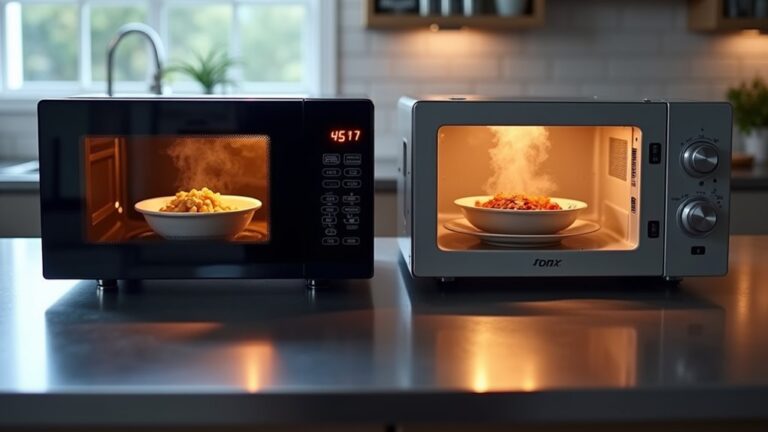
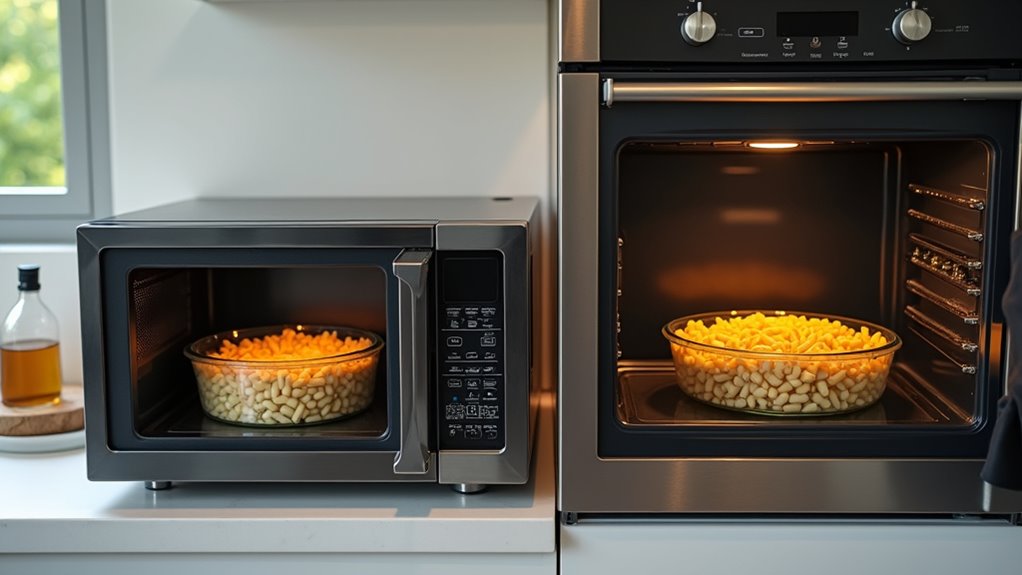
Microwaves heat quickly but can leave cold spots unless food is stirred or covered. Ovens heat more evenly and produce crisp textures, though they take longer and use more energy. Safety depends on reaching a safe internal temperature throughout the dish rather than the appliance alone. Match method to food type: soft, saucy leftovers suit microwaves; crispy, baked items benefit from ovens. Proper reheating technique delivers both safe and tasty results.
Microwave or Oven: Which Reheats Better?
Most of the time, the microwave wins on speed, but the oven usually wins on quality. In appliance comparisons, you’ll see that the microwave heats leftovers in minutes and saves energy for single servings. Still, energy myths can confuse you, because faster doesn’t always mean better.
Should you want the best texture, the oven keeps baked goods, pizza, casseroles, and roasted meats from turning soggy or rubbery. It warms food gently and evenly, so you get a crisp edge and a softer center.
For safety, both methods should reach 165°F, so use a food thermometer and let the food rest briefly. As you decide, consider what you want to feel at the table: quick relief or a meal that tastes cared for.
When to Use the Microwave
Use the microwave while you need dinner back on the table fast and you don’t want to waste extra energy on a small portion. It’s your best bet for soups, stews, rice, pasta, and saucy leftovers that only need 1 to 3 minutes.
For smart speed tips, spread food in a shallow layer, cover it with a vented lid or damp paper towel, and stir halfway so cold spots don’t hide bacteria. Check that the center reaches 165°F, then let it stand for 1 to 2 minutes.
Choose microwave-safe containers only, because regular plastic, styrofoam, and foil can cause trouble. In case your meal was frozen, thaw it initially or use defrost mode. You’ll get better energy savings and a smoother mealtime groove.
When the Oven Is the Better Choice
Whenever the meal needs a little rescue, the oven often does the better job. You’ll want it for pizza, roasted meats, casseroles, and baked goods because low, even heat brings back crisp crusts and steady texture.
Preheat to 325 to 350°F, set the food in an oven-safe dish, and cover it with foil so moisture stays in. Should you need extra flavor restoration, uncover it for a few minutes at the end.
For big or dense leftovers like lasagna or a whole roast, the oven helps the center reach 165°F without drying the outside. Add a splash of water or broth for rice or braised meats.
A convection or toaster oven can also improve energy efficiency while browning faster.
How to Reheat Leftovers in the Microwave
In case the oven feels like more work than the leftovers deserve, the microwave can save dinner in a hurry. Use microwave-safe container safety initially, then spread food in an even layer. Cover it with a vented lid or damp paper towel, and heat in 30 to 60 second bursts. Stir between rounds so you don’t trap cold spots. For casseroles, pasta, or meat, lower power to 50 to 70%. Add a splash of water, broth, or sauce to rice and other starches to keep them soft.
| Step | What you do |
|---|---|
| 1 | Pick a microwave-safe container |
| 2 | Cover with steam escape |
| 3 | Heat in short bursts |
| 4 | Stir and adjust power |
| 5 | Check 165°F, then rest |
Ignore microwave myths, and never reheat food twice.
How to Reheat Leftovers in the Oven
The oven gives leftovers a second life with steady, even heat, so they can warm through without turning soggy or uneven.
You should preheat it to 325 to 350°F, then move your food into an oven-safe dish.
Next, add a small splash of water, broth, or sauce to rice, pasta, or meats, and cover the dish with foil tenting to keep in moisture.
For casseroles or lasagnas, heat them for 15 to 25 minutes, then uncover for the last 5 minutes so the top wakes up again.
Should you be warming pizza or bread, set them on a baking sheet at 350°F for 5 to 10 minutes.
Check for 165°F inside, especially with acidic sauces, then let it rest 1 to 2 minutes.
Best Foods for Microwave Reheating
Microwave reheating works best whenever the food already has a soft, moist texture, so you can save time without wrecking the meal. You’ll do well with soups, stews, rice, mashed potatoes, saucy pasta, casseroles, and steamed vegetables.
Use microwave friendly containers, then cover the food so steam stays in and helps everything heat evenly. For rice and potatoes, add a splash of water and stir now and then. For soup, stir halfway and heat until it reaches 165°F.
For eggs or small vegetable portions, use short bursts at lower power so they stay tender. These quick steam techniques help you keep dinner familiar, cozy, and ready fast.
Skip dense steaks, fried foods, and crusty bread, since they usually turn soggy instead of satisfying.
Best Foods for Oven Reheating
Whenever you use the oven, you can bring back the best texture in pizza, fried chicken, and other crispy foods without turning them soggy.
It also helps baked goods and pies stay crisp outside while warming the inside gently.
For roasted meats and fish, the oven gives you even heat that keeps them tender instead of tough.
Baked Goods And Pies
Baked goods and pies often do best in the oven because gentle heat brings back the crisp crust, flaky layers, and warm filling that make them feel fresh again. You keep that texture contrast, and you help seasonal fillings stay cozy without turning soggy.
Preheat your oven to 325 to 350°F, then warm slices for 5 to 10 minutes or whole pies for 15 to 20 minutes. Provided the top browns too fast, cover it loosely with foil initially, then uncover it for the last few minutes so it re-crisps nicely.
For one slice, you can use a toaster oven or air fryer at 350°F for 3 to 7 minutes. Add a few drops of water to bread-based items, and check thicker pies reach 165°F.
Roasted Meats And Fish
Roasted meats and fish usually come back to life best in the oven, especially after you’ve already handled softer leftovers like pies and baked goods.
You’ll get better texture restoration and flavor preservation whenever you use steady heat instead of rushing it. Keep your oven at 325 to 350°F, cover the food, and warm it until the center hits 165°F.
- For roast beef or whole chicken, add a splash of broth and tent it with foil.
- For thin fish fillets, use 300 to 325°F and wrap them in foil or parchment.
- Check the temperature every 5 to 10 minutes, afterwards rest the meat for 1 to 2 minutes.
That gentle pace helps you keep dinner juicy, tender, and worth sharing.
Pizza And Crispy Foods
Pizza and other crispy leftovers deserve a gentler kind of comeback, because the wrong heat can turn a great crust into a sad, bendy letdown.
You’ll do best with an oven or toaster oven at 350°F for 8 to 10 minutes. Set slices on a preheated baking sheet or wire rack so hot air moves under them and protects crust integrity. Should the top start browning too fast, cover the edges with foil. That helps you avoid cheese separation while the center melts evenly.
For a faster fix, use an air fryer or convection toaster oven at about 400°F for 2 to 4 minutes.
Skip the microwave, since it traps steam and makes crisp edges chewy.
For thick fried pieces, go lower and slower.
How to Reheat Leftovers Safely
To keep leftovers safe, you should always heat them until they reach 165°F, then let them sit for a minute or two so the warmth spreads evenly.
Use the microwave for soups or single servings, the oven for casseroles and pizza, and the stovetop for foods that need stirring and a little extra moisture.
No matter which method you choose, reheat each dish only once and store it in the fridge within two hours so it stays tasty and safe.
Safe Reheating Temperature
For safe reheating, you want your leftovers to reach 165°F throughout, because that temperature helps kill the bacteria that can make you sick. You can feel confident whenever you check the internal temp with a food thermometer in the thickest part, away from bone or pan. Then give the food a short resting time so the heat settles evenly and keeps working.
- Recheck the center provided the dish is thick or dense.
- Stir and rotate microwaved food, then try a few spots.
- Refrigerate any extra portion within two hours and don’t reheat it again.
That simple habit helps you and your table stay in the safe zone without extra stress. Once you know the target, leftovers feel less like a gamble and more like a smart, easy win.
Even Heating Methods
Even better, reheating leftovers safely is less about blasting them hot and more about warming them all the way through. You want every bite to reach 165°F, then rest 1 to 2 minutes so the heat settles. In a microwave, fight cold spots by stirring midway, using a shallow layer, and covering the food with a vented lid for better steam distribution. Should the container shape be deep, switch it to a wider dish.
| Method | Best Use | Key Move |
|---|---|---|
| Microwave | Quick meals | Stir and cover |
| Oven | Casseroles | Preheat and foil |
| Stovetop | Soups and grains | Stir and add liquid |
Ovens usually give steadier heat, and the stovetop gives you gentle control. Also, cool leftovers fast, refrigerate them within two hours, and don’t reheat them twice.
Food-Specific Reheating Tips
Whenever you’re reheating leftovers, the right method depends on what’s on your plate, because a soup shouldn’t be treated like a slice of pizza.
You can keep your meal safe and tasty by matching heat to texture and portion sizes.
- For soups, stews, rice, and saucy dishes, cover them, stir midway, and add a splash of water or broth so they heat evenly.
- For pizza, fried foods, casseroles, and roasted meats, use the oven or toaster oven at 325 to 350°F, and tent with foil so crisp edges stay friendly.
- For meats and dense items, use low heat on the stovetop, keep a lid on, and add a little liquid.
A quick re-sear can wake up the crust.
Always check for 165°F, rest it 1 to 2 minutes, and skip reheating twice.
Herb refreshers can brighten the last bite.
Frequently Asked Questions
Is It Better to Reheat Food in the Oven or Microwave?
You’ll usually pick the microwave for speed and energy efficiency, but the oven wins for texture preservation. Choose based on your leftovers: microwave soups, oven pizza. Either way, you’ll feel right at home reheating safely.