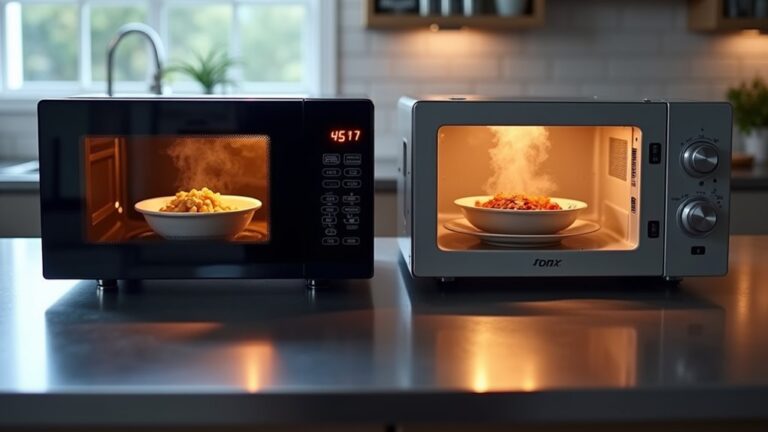
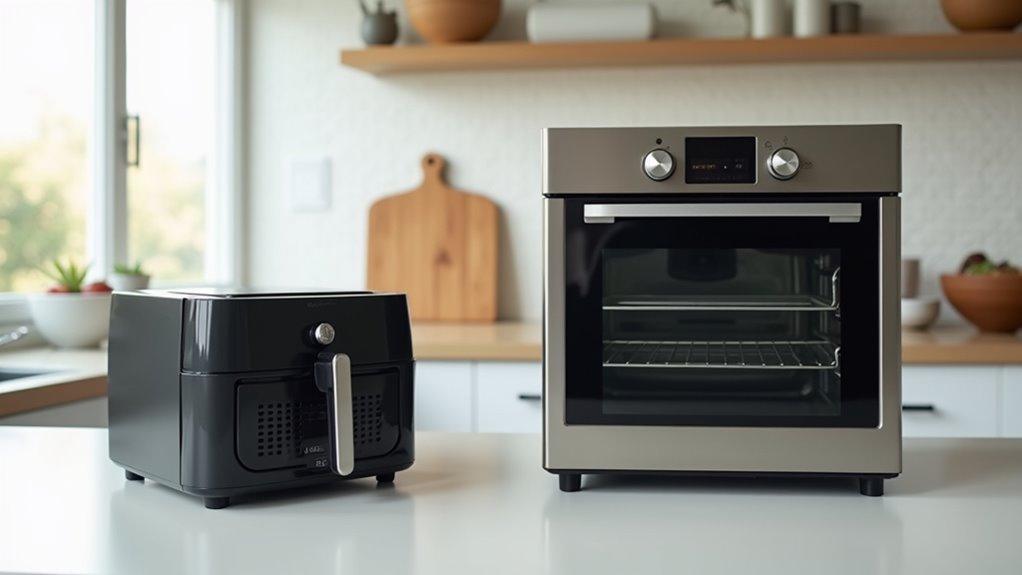
Air fryers crisp frozen fries faster than convection ovens because they circulate intense hot air in a compact chamber. Convection ovens use a fan to move air over a larger space, producing more even roasting and baking. Air fryers work best for small batches and quick browning. Convection ovens handle larger quantities and gentle reheating better. Choose based on batch size, desired crispness, and countertop space.
Is an Air Fryer a Convection Oven?
Yes, an air fryer is a kind of convection cooker, but it isn’t the same thing as a standard convection oven. You can regard it as a smaller, faster helper that uses a strong fan and tight heat to imitate frying.
In the history origins of these appliances, makers leaned on marketing claims about crispier food with less oil, and that message stuck because it feels easy and friendly. Still, your air fryer works in a compact space, so it pushes hot air harder around one basket or rack. That’s why it heats quickly and often gives you crunchier results.
A convection oven, on the other hand, spreads heat more evenly for bigger meals and more racks. Should you prefer simple wins in the kitchen, both can fit your routine.
Air Fryer vs. Convection Oven at a Glance
At a glance, air fryers and convection ovens do a similar job, but they do it in very different ways.
You’ll notice an air fryer is a compact health helper for quick meals, with a small basket and strong heat that gives food a crisp finish fast.
A convection oven gives you more room, so you can cook several dishes at once and bake or roast with steady results.
Should you be cooking for one or two, the air fryer often feels easier and faster. Should you be feeding a crowd, the convection oven fits better.
You might also notice differences in noise levels, since the smaller fan can sound sharper.
Whenever you swap recipes, trim the temperature a little or shorten the time.
How Each Appliance Circulates Hot Air
Both appliances move hot air with a fan, but they don’t push it the same way. In an air fryer, you get stronger, faster airflow patterns that sweep hot air tightly around your food. That quick movement helps the surface brown and crisp with less wait.
In a convection oven, the fan spreads heat more gently through a larger chamber, so you get steady cooking and better heat distribution efficiency across racks. Should your oven has true convection, a rear element can enhance that even flow.
Whenever you use baskets, trays, or low-sided pans, you help the air reach more surfaces. So you can choose the style that fits your meal and still feel confident at the stove.
Air Fryer vs. Convection Oven Size Differences
Size is where these two appliances really start to split apart. | Appliance | Typical Size | Best Fit |
| — | —: | — |
|---|---|---|
| Air fryer | 2 to 6 quarts | Small meals |
| Air fryer | Small countertop unit | Tight kitchens |
| Convection oven | 30″ wide | Family cooking |
| Convection oven | Large cavity | Multiple racks |
| Air-fry oven | Full-size range | Bigger batches |
You’ll notice the air fryer’s countertop footprint stays small, so it fits easily beside your other tools. That compact shape works well whenever you want quick meals for one or two people. But its batch capacity is limited, so you might need to cook in rounds. A convection oven gives you much more room, and you can spread food across racks without crowding. In the event that you cook for a crowd or want one appliance that can handle bigger portions, that extra space feels reassuring. For many homes, the choice comes down to how much food you usually make and how much kitchen space you can spare.
Preheat and Cook Time Differences
As you’re comparing an air fryer with a convection oven, preheat time is one of the initial things you’ll notice. Your air fryer usually wins here with rapid preheating, often ready in 2 to 4 minutes. A full-size convection oven usually needs 8 to 12 minutes, so you might wait longer before cooking starts. That gap matters on busy nights whenever you want dinner moving fast.
Cook time also shifts. You can often trim air fry recipes about 20 percent, and convection recipes about 25 percent. Many brands also suggest lowering heat about 20 to 25 degrees. Because air fryers push stronger airflow, delicate foods could brown sooner. Provided you’re cooking for a crowd, staggered batches can help you keep everything hot and timed right.
Best Temperatures for Crisp Food
For crisp food, temperature matters just as much as airflow, and a few degrees can make the difference between golden and soggy.
You’ll usually get the best crunch in an air fryer among 350°F and 500°F, with 400°F to 450°F giving fries and wings that high heat searing finish you crave.
In a convection oven, you should drop the usual setting among 20°F to 25°F, or cut the recipe temperature among 25°F and trim the time a bit. That keeps the surface from overbrowning while still helping oil free crisping shine.
For the best results, use a perforated tray or low-sided pan, and keep oil light, just a spray or about a tablespoon. That way, your food gets crispy, not greasy.
Why Air Fryers Crisp Faster
Air fryers crisp faster because they create a hotter, tighter cooking zone around your food. Their compact chamber and strong fan push superheated air across the surface, so heat builds quickly and moisture leaves sooner. That means you feel the crunch start earlier, even with less oil.
Because preheat time is short, often under five minutes, the basket reaches the right temperature fast, and Maillard browning starts sooner too. In practice, airflow behavior matter a lot: the moving air keeps fresh steam from hanging around and helps dry the outside. Perforated baskets also expose more surface area, so you get a crisp shell instead of a soggy patch.
Should you’ve ever wanted food that feels confidently done, this setup helps you get there with less waiting.
Best Foods for an Air Fryer
You’ll get the best results with foods that already have a dry, sturdy coating, like frozen fries, chicken nuggets, mozzarella sticks, wings, and potato wedges.
The air fryer also shines while you’re bringing leftovers back to life, because it can make breaded foods crisp again without turning them soggy.
Just skip wet batters, rice, popcorn, and soft cheeses, since they usually won’t set well and can make a mess fast.
Best Air Fry Foods
Some of the best air fryer foods are the ones that already have a crisp coating or a shape that lets hot air move all around them. You’ll feel right at home whenever you make easy meals that turn out golden and satisfying.
- Frozen snacks like french fries, chicken nuggets, and mozzarella sticks crisp up fast, so you can serve a crowd without stress.
- Small chicken pieces, like wings, tenders, and drumettes, cook evenly and fit right into busy weeknight dinners.
- Potatoes, Brussels sprouts, cauliflower, and carrot fries get caramelized with just a little oil.
- Leftover fried or breaded foods regain their crunch in minutes, which helps you save time and avoid soggy bites.
These choices make your air fryer feel dependable, especially whenever you want comfort without much fuss.
Ideal Crispy Ingredients
Crispy foods almost always shine in an air fryer because the hot air can sweep around them and dry the surface fast. You’ll get the best results with foods that stay thin, dry, and spaced out.
| Food | Time | Temp |
|---|---|---|
| Fries | 10-15 min | 400°F |
| Wings | 25-35 min | 400-450°F |
| Brussels sprouts | 12-20 min | 375-400°F |
| Tater tots | 10-15 min | 400°F |
| Fish sticks | 6-12 min | 350-375°F |
These choices fit your basket well and help you feel like you nailed dinner. Frozen breaded snacks, chicken tenders, and plant based snacks all crisp up with little fuss. Small wedges of seasonal produce also turn golden with just a light oil touch. Whenever you want that fried-style bite, keep pieces in one layer so the air can do its job.
Foods To Avoid
Not every food plays nice with an air fryer, and that can save you from a frustrating mess. Once you know the troublemakers, you can cook with more confidence and still feel like you’re part of the crispy-food club.
- Wet-battered foods like tempura can lose coating fast.
- Large whole roasts or chickens often cook unevenly in small baskets.
- Custards and soufflés might crack, sink, or turn rubbery.
- Foods with lots of liquid, plus delicate sauces, require another method.
Also, skip loose shredded cheese unless it has a barrier, or it could melt through the basket. Should you want crunch, choose Batter alternatives that set quickly. That way, you’ll avoid soggy edges, greasy drips, and undercooked centers, and you’ll get results that fit your kitchen and your people.
Best Foods for a Convection Oven
Whenever you use a convection oven, you get even heat that works especially well for roasted meats and poultry, casseroles and bakes, and cookies, pies, and bread.
You can count on it to brown larger cuts nicely, heat layered dishes through gently, and give baked goods a steady, crisp finish.
Should you adjust the temperature a little, you’ll get even better results without the stress of guessing.
Roasted Meats And Poultry
Roasting meat in a convection oven gives you a real advantage, especially with bigger cuts and whole poultry that need steady heat all the way through. You get even browning, juicy centers, and a crust that feels made for your table.
- For turkey or a whole chicken, use true convection so the rear fan moves heat across every rack.
- Cut published times by about 25% or lower the temperature by 25°F.
- Check resting temperatures with a probe, and aim for 165°F for poultry or 145 to 160°F for meat.
- Try brining techniques before roasting to help hold moisture and enhance flavor.
Because the heat stays gentle and balanced, you can cook with confidence and serve food that brings everyone in.
Casseroles And Bakes
Casseroles shine in a convection oven because the fan keeps heat moving evenly through the whole dish, so you get a bubbly center and a nicely set top without babysitting the pan. You’ll feel right at home whenever your lasagna, mac and cheese, or other saucy bake comes out tender, not dried out.
For best results, set convection bake and drop the recipe temp by 25°F, or shave off about 25% of the time. That little adjustment protects moisture retention and keeps the edges from getting tough.
In case you’re cooking for a crowd, multi rack stacking helps you bake two casseroles at once with steady results. Just skip strong convection for delicate custards or soufflé-style bakes, since too much air can make them rise unevenly and ripple on top.
Cookies, Pies, And Bread
Cookies, pies, and bread often do best in a convection oven because the moving heat gives you steady browning without making you hover over the door. You get even browning, better crusts, and less worry about hot spots, so your bakes feel more reliable.
- For cookies, lower the set temperature by about 25°F so the edges don’t race ahead.
- For pies, use standard oven-safe pans and watch the last few minutes closely.
- For bread, convection helps with oven spring and a prettier crust, especially when you use dough scoring.
- In case your oven runs unevenly, rotate the pans once for a fair bake.
That gentler airflow also beats air-fry style blast for delicate doughs, because it helps your batch stay soft inside while turning golden on top.
Foods That Don’t Work Well in Air Fry Mode
Not every food is a good match for air fry mode, and that’s okay. You can still cook with confidence provided you know the limits.
Wet coatings, like beer batter or tempura, get blown around before they set, so they stay patchy instead of crisp. Soft, melting cheeses such as fresh mozzarella also slip and leak, which leaves a gooey mess instead of a tidy crust.
Then there are foods that need plenty of moisture or space, like whole tomatoes, leafy greens, large chickens, and big roasts. In air fry mode, they can steam, crowd, or cook unevenly.
Even doughnuts and similar treats might brown, but they won’t get that rich, tender bite you’re hoping for.
Can a Convection Oven Replace an Air Fryer?
Yes, a convection oven can often step in for an air fryer, especially provided it has a strong fan or a dedicated Air Fry setting. You mightn’t get the same snap-fast crunch, but you can still make food feel right at home.
- Use a single rack for better airflow.
- Pick a low-sided tray or perforated basket.
- Expect a little more time than a countertop fryer.
- Enjoy space saving benefits should your oven replace a second appliance.
That swap also helps with noise levels, since many ovens run more quietly than small fryers.
Were you to cook for your crew, a convection oven’s larger capacity makes shared meals easier. And should your range includes an Air Fry mode, you get both convenience and comfort without crowding your counter.
How to Convert Recipes for Air Fry
As you convert a recipe for air fry, start by lowering the oven temperature about 25°F and cutting the time about 20%.
In case you’re moving a convection recipe over, keep the temp close and check it 15 to 25% sooner since air fry mode cooks faster.
For small foods like fries or wings, use little oil, flip or shake halfway, and watch them closely toward the end so they crisp up without drying out.
Temp Reduction Rule
A good rule of thumb is to turn down the heat a little before you switch a recipe to air fry. You’ll usually drop the temperature by 20 to 25°F, because the hot air moves faster and cooks more strongly.
Should you’re unsure, check your oven calibration firstly, and note altitude adjustments can also shift results a bit.
- Lower the set temp by 20 to 25°F.
- Read your oven manual should it has Air Fry or convection modes.
- Skip extra changes unless the oven already cuts about 25°F.
- For convection baking, keep the same time or trim it initially by 25% while you watch doneness.
That way, you stay in control and cook with confidence.
Time Adjustment Method
Getting the timing right is just as vital as setting the right heat, because air fry cooks faster than a regular oven and can change how a recipe turns out.
For timing calibration, cut the original cook time by about 20%, or check at 75 to 80% of the listed time. Should you’re moving from convection, your oven might already handle some of that shift, so you could only need a small trim.
For fries, wings, and other thin foods, start your doneness checkpoints 5 to 10 minutes sooner. For roasts or thick cuts, keep the main timing steadier and let browning finish at the end.
Whenever you’re unsure, use an instant read thermometer, because safe centers matter more than guesswork. That way, you fit in with the air fry crowd fast.
Recipe Conversion Tips
To turn a conventional oven recipe into an air fryer recipe, start making two quick changes: lower the temperature approximately 25°F and cut the cook time roughly 20 percent. You’ll fit right in once you trust that simple math.
- Check early. Air Fry mode cooks faster, so peek several minutes before the timer ends.
- Use the right pan. A perforated basket or low-sided pan helps the hot air move around your food.
- Make smart swaps. Small ingredient swaps can help with browning, while batch scaling keeps portions from crowding.
- Assess doneness. Use a thermometer for meats, like 165°F for chicken, and add short time bursts as required.
In case your oven behaves extra hot, convert cautiously and adjust gradually.
How to Convert Recipes for Convection
As you switch a recipe from a regular oven to convection, you can usually keep the same dish and still get better browning with less guesswork. You’re not changing the heart of the recipe, just helping it cook more evenly.
Start by lowering the temperature about 25°F, or keep the heat the same and cut the time about 25%. For air fry settings, drop the temp 25°F and shave off about 20%.
In your kitchen, watch the Fan Direction, use good Ingredient Spacing, and choose a Crisper Tray whenever you want extra airflow. Should you bake on more than one rack, do Rack Rotation halfway through. Check food 5 to 10 minutes sooner, and use a thermometer for meats.
Which Works Better for Your Kitchen?
Which one works better in your kitchen really depends on how you cook day to day. Should you live in space saving layouts, an air fryer can fit your rhythm fast.
- Choose an air fryer for quick, crispy single-serve meals.
- Pick a convection oven whenever you cook big batches or multiple trays.
- Go with convection for better roasting, baking, and even results.
- Use energy efficiency comparisons to weigh small quick jobs against larger family meals.
An air fryer heats in minutes and keeps cleanup easy, so it feels friendly on busy nights. A convection oven takes more time, yet it gives you room to grow, share, and cook with confidence. Assuming you want that golden crunch, the air fryer wins. In case you want flexibility, the convection oven belongs in your kitchen.
Frequently Asked Questions
How Do Cleaning Requirements Differ Between Air Fryers and Convection Ovens?
You’ll clean air fryers faster because removable baskets and nonstick coatings wipe down easily, while convection ovens need you to scrub racks, trays, and interior surfaces more thoroughly. Still, both keep your kitchen crew ready.
Which Appliance Uses Less Energy During Everyday Cooking?
You’ll usually save a mountain of electricity with an air fryer, thanks to lower energy consumption and greater cooking efficiency. You’re part of the smart cooking crowd whenever you choose the appliance that heats faster and cooks smaller meals.
What Accessories Come With Air Fryers Versus Convection Ovens?
You’ll usually get basket inserts with air fryers for crispier results, while convection ovens often include baking pans, racks, or trays. You can feel right at home choosing whichever extras match your cooking style.
Are There Safety Differences Between Countertop and Built-In Models?
Yes, countertop models usually require more clearance and careful placement, while built in units often include safer venting requirements and sometimes a child lock. Choose whichever fits your kitchen best for greater security.
How Do Noise Levels Compare While They’Re Operating?
You’ll usually hear more fan noise from an air fryer, while a convection oven hums softer; motor vibration can add a bit of buzz. Either way, you are in good company choosing the quieter fit.